Most people who book a body contouring session have never had one before, and the not-knowing is the uncomfortable part. Is it a machine you climb into? Does it burn? Do you undress? Is somebody going to look at your midsection and say something you do not want to hear?
None of that is what happens. But "trust me, it's fine" is not a useful answer, so this is the full walkthrough — what happens from the moment you park on Laurel Bowie Road to the moment you leave, what the session actually feels like, and when you can expect to see the difference.
Most people walk out of their first session a little surprised at how easy it was, and a lot more motivated than when they walked in.
What to Expect at Your First InvisaRED Session
Here is the short version of what to expect at your first InvisaRED session: you will be in the office about an hour, most of that is talking and measuring, and the treatment portion itself is roughly 15 to 20 minutes per area, lying down, fully relaxed, with flexible pads resting against your skin. There are no needles, no cold, no suction, and no recovery time. You will drive yourself home and go about your Saturday, and your body will keep working on what the light started for the next couple of days.
The reason a first visit runs longer than the treatment is that the first visit includes your baseline. We measure you carefully before anything is turned on, because that is how you get to watch your own numbers move over the series.
Before you arrive
A few things make the first session go better:
- Wear or bring two-piece clothing. The pads need direct contact with skin over the target area. A loose t-shirt and separate bottoms is ideal. You will not be asked to change into a gown.
- Hydrate the day before, not just the hour before. Water matters for the lymphatic piece we will get to below.
- Skip heavy lotions, oils and self-tanner on the treatment area that morning. They sit between the pad and the skin.
- Eat normally. This is not a fasting protocol and you should not arrive lightheaded.
- Bring your medication list. Some medications increase light sensitivity, and that changes the conversation.
The intake and consultation
We start seated, not on the table. The questions are the ones you would expect — what you are hoping to change, what you have already tried, your general health history, whether you are pregnant or trying to become pregnant, whether you have any history of cancer or are currently in treatment for it, and what medications and supplements you take.
Two of those matter more than the rest. Pregnancy and active cancer are the standard screening exclusions in the published body contouring research, and photosensitivity disorders and light-sensitizing medications are the third. The six-week clinical trial published in the Journal of Clinical and Aesthetic Dermatology excluded participants for exactly these reasons, along with pacemakers and prior cardiac surgery, prior surgical body sculpting, active infection or open wounds in the treatment area, and medications known to affect body weight or cause fluid retention.
If something on that list applies to you, it does not automatically end the conversation — it just means we talk it through first, and sometimes loop in your physician.
The measurements
This is the part people underestimate, and it is the part that makes the whole thing accountable.
Before anything is turned on, we take baseline circumference measurements with a tape at the sites you want to address — typically waist, upper abdomen, hips and thighs. We record the reference points, meaning the distance from a fixed landmark like the hip bone to where the tape sat, so that every future measurement is taken in the exact same place.
That sounds fussy. It is the difference between a real measurement and a flattering one. In the JCAD trial, the same trained person took every measurement at each site for that exact reason. We hold ourselves to the same standard, so when your waist number drops, you know it is real.
We also take a weight and, in most cases, before photos. You will be measured again at set intervals so you can see the trend build across the series. Take your own photos at home too, same spot, same light, same time of day. The before-and-after is the part patients end up most excited about.
The Session Itself, Step by Step
Pad placement — about five minutes
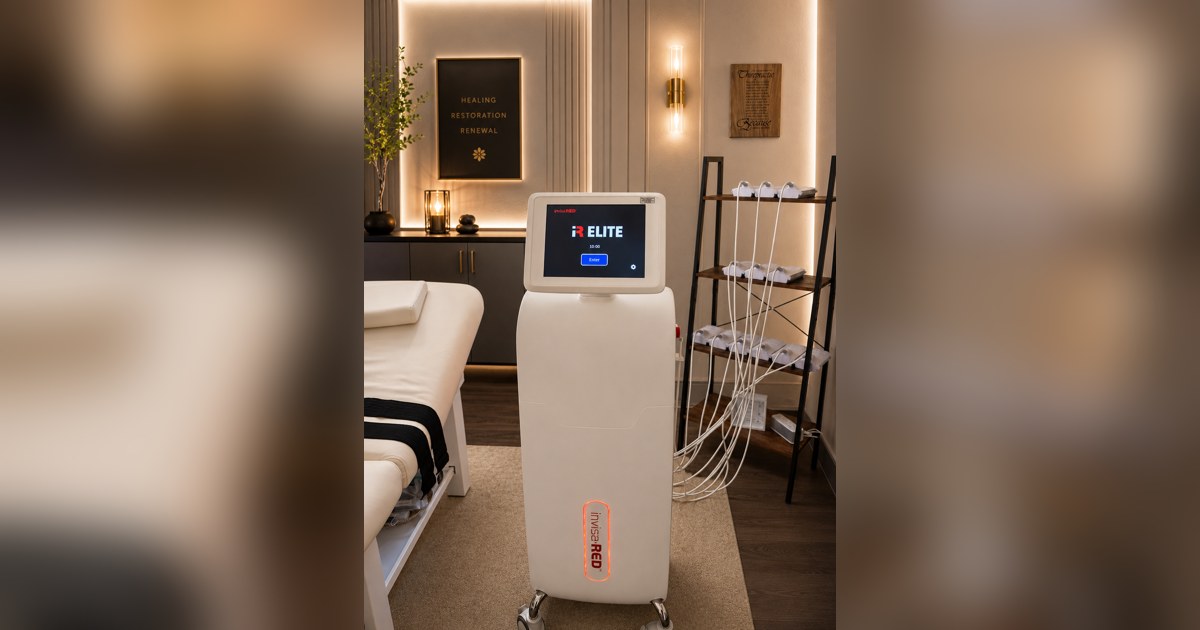
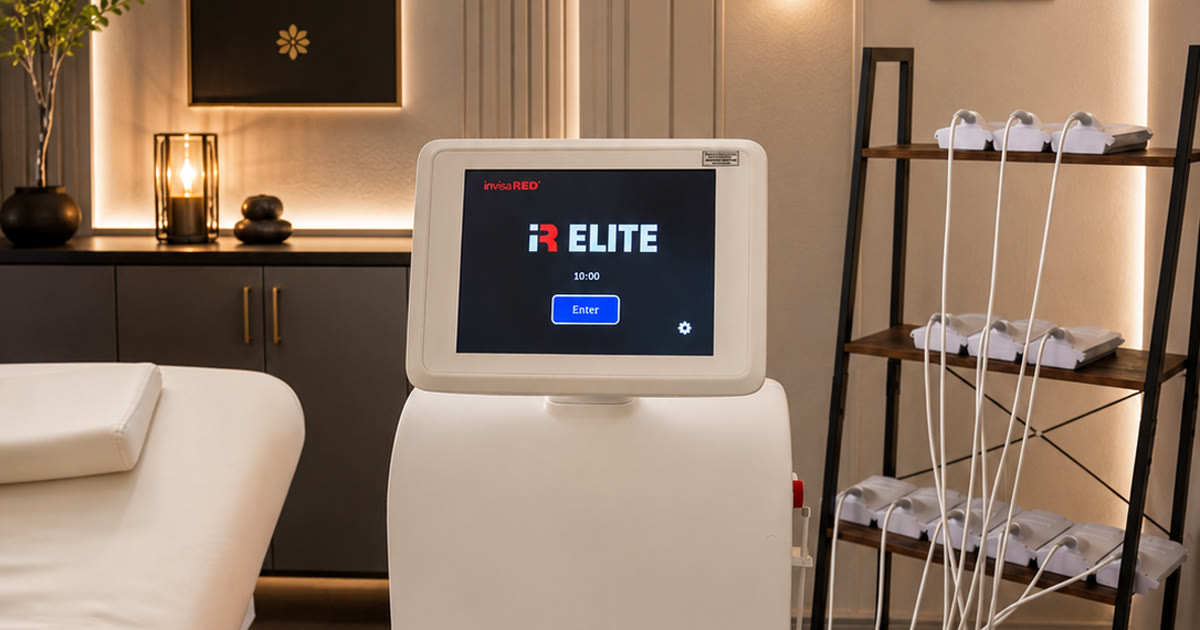
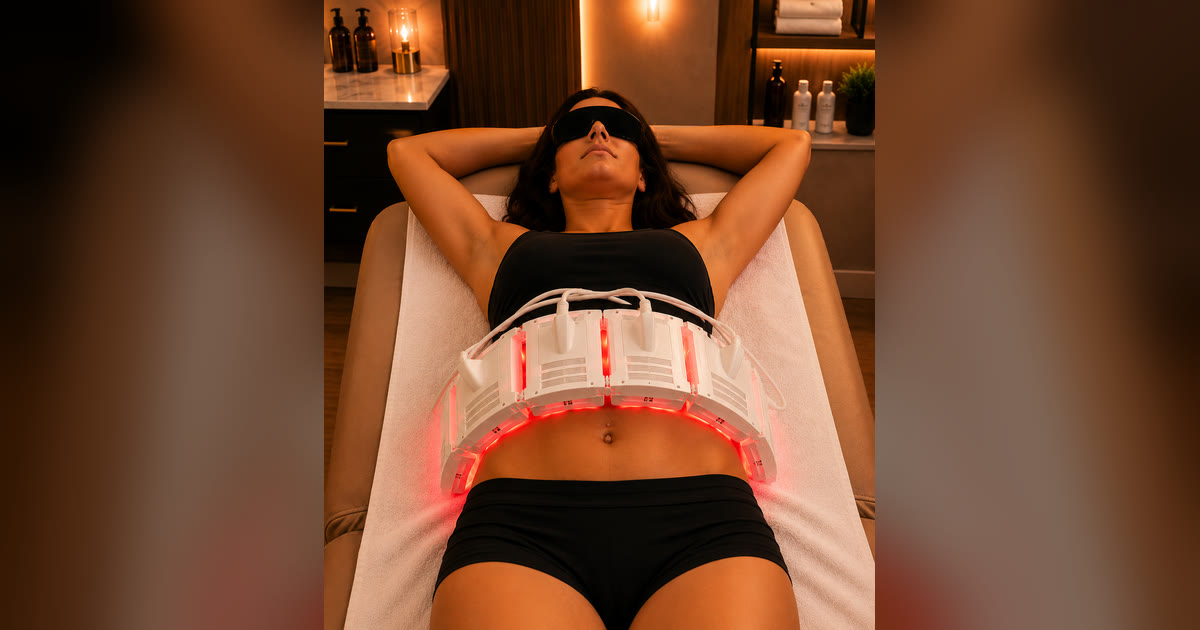
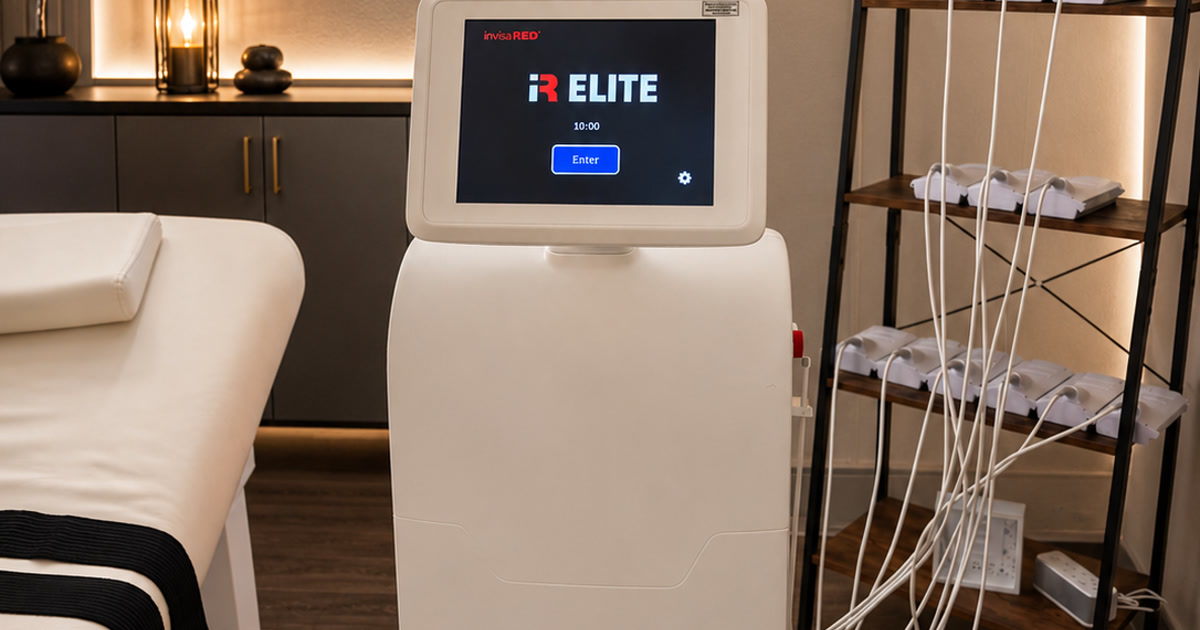
You lie down on the treatment table, face up, with the target area exposed. The InvisaRED iR Elite system uses flexible pads rather than an overhead scanner, and they are positioned in direct contact with the skin and secured with a belt or wrap so they stay put.
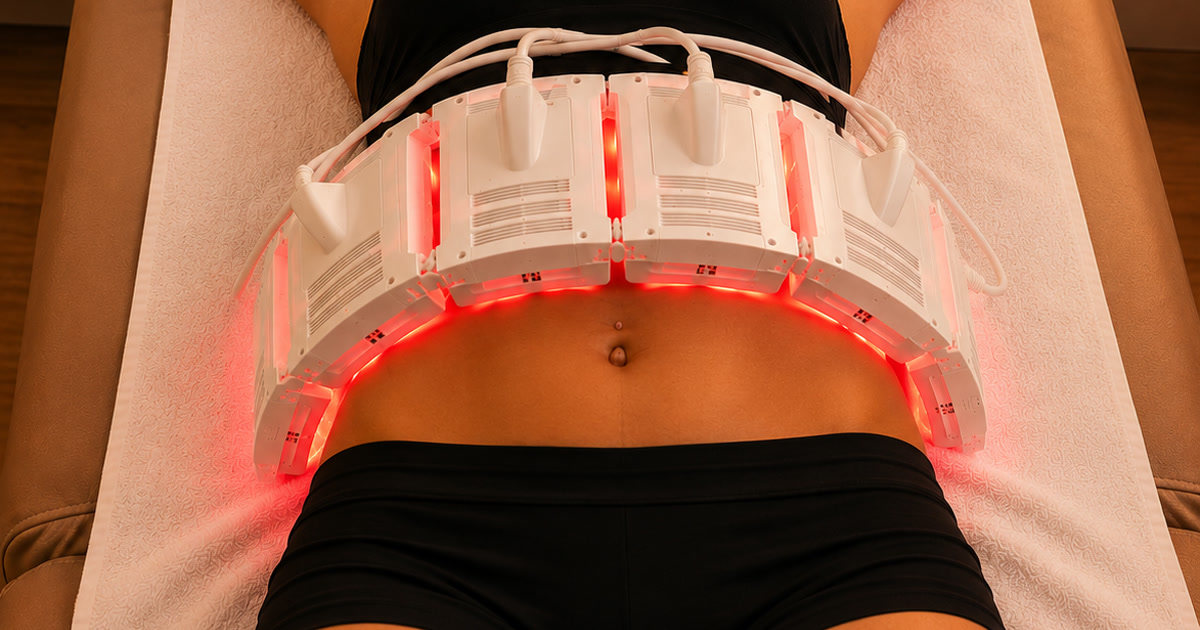
Contact is the whole point. A panel across the room and a pad against your abdomen are not delivering the same thing to the same depth, which is why we do not treat this as interchangeable with a red light panel you might have used at a gym.
You will be given eye protection. That is not theater — direct laser light to the eye is one of the few genuine absolute contraindications in this entire category, so we protect against it even though the pads are nowhere near your face.
The treatment window — 15 to 20 minutes per area
Then, essentially, nothing happens to you.
The manufacturer's own guidance puts treatment time at roughly 15 to 20 minutes per session per area. You lie there. Patients read, scroll, text, listen to music, or fall asleep — which happens more often than you would think, particularly in a late-afternoon appointment.
If we are treating front and back of the same region, you will be turned over partway through and the second half runs the same way.
What it actually feels like
Mild warmth, or nothing at all.
There is no heating element and no cooling, no vacuum, no vibration, no pressure beyond the light weight of the pads. Some people describe a faint warmth under the pad; a fair number describe no sensation whatsoever and spend the first session wondering whether the machine is on.
There is no post-session soreness, no bruising, no numbness and no recovery period. In the six-week trial cited above, across 54 participants, the investigators recorded no adverse events and no evidence of skin changes in the treated areas. That is consistent with what we see in the office, and it is the single most reliable thing anyone can say about this modality.
The part after the pads come off
This is where the easiest part of your job starts.
Here is what just happened under the pads. The light triggered your fat cells to open temporary pores in their membranes and release stored contents, triglycerides, free fatty acids and glycerol, into the surrounding space. The cells shrank. Your lymphatic system is now carrying that released fat into circulation, where your body burns it as fuel.
That fat does not disappear on its own. Your body has to metabolize it, and that is where the energy math gets interesting. InvisaRED reports that a single session can trigger a metabolic response equivalent to burning up to roughly 2,000 calories, and that your metabolism stays elevated for up to 72 hours afterward. That is why we ask for three things after every session: you are giving your body the signal to use what was just released as fuel.
| After the session | Why it matters |
|---|---|
| Move for 10–30 minutes — a walk is plenty | Muscle activity and circulation are how your body burns the released fat |
| Drink water through the rest of the day | Lymphatic transport is fluid-dependent |
| Keep meals reasonable | The goal is to burn what was released, not restore it |
Done one to three times a week over a series, that is a meaningful push toward both inch loss and weight loss. Individual results may vary.
When You Will See Results
Many patients notice a difference on the tape after the first session or two, and a fair number tell us their clothes fit differently within the first couple of weeks. The results build with each visit, because every session releases more stored fat and your body keeps burning it between appointments. We track your measurements at set intervals so you see your own numbers, not a brochure's.
If you want the mechanism rather than the timeline, I wrote it up separately in how red light body contouring actually works.
Here is what the six-week JCAD trial found, in 54 adults with a BMI between 25 and 40, using one 635 nm session per week for six weeks:
| Measurement site | Mean reduction |
|---|---|
| Waist | 1.8 inches |
| Upper abdomen | 1.3 inches |
| Hips | 1.2 inches |
| Right thigh | 1.1 inches |
| Left thigh | 0.9 inches |
| Combined, at 6 weeks | 5.4 inches |
| Combined, 2 weeks after the last session | 6.2 inches |
Roughly 72 percent of participants hit the study's pre-set threshold of a 4.5-inch combined reduction, and 81 percent rated themselves satisfied or very satisfied with the aesthetic result. Notice that the combined number kept improving two weeks after the last session. That is the mechanism at work: your body keeps burning what was released.
That is a comfortable, non-invasive option with published support, a clean safety record, and results you can measure in inches. It is also very different from the freeze-and-destroy category, which I compared directly in InvisaRED vs CoolSculpting.
Inches First, Then the Scale
InvisaRED works on both the tape measure and the scale, and the tape usually moves first. In a Mayo Clinic randomized pilot, Croghan and colleagues treated adults with a BMI of 25 to 29.9 twice a week and measured about 2 inches off the waist at six weeks, along with drops in body weight, BMI and fat mass. The six-week JCAD protocol above recorded 5.4 combined inches with 81% satisfaction.
Here is why the inches show up before the pounds: fat tissue is light but takes up space. Shrinking the fat cells in your midsection changes how your clothes fit weeks before it changes the number on the scale. That is not a limitation. That is the fastest visible win in weight loss, and it is the one most people have been chasing for years. I wrote more about it in how InvisaRED helps you lose inches and pounds. Individual results may vary.
Some of our best results come from combining InvisaRED with our doctor-supervised weight loss program. The medical side helps regulate appetite and supports your metabolism across the whole body. InvisaRED targets the specific areas you want to shrink and gives your metabolism an extra push after every session. Patients tell us the combination keeps them motivated, because they see their waistline changing while the scale catches up. Ask about it at your first visit.
Who Is a Good Candidate
InvisaRED is a good fit for a wide range of people: someone 10 to 20 pounds from their goal with a stubborn midsection, someone starting a weight loss program who wants to see results fast enough to stay motivated, someone already on a medical weight management program who wants to target the areas the medication is leaving behind, and someone who simply wants a smaller waist without surgery, needles or recovery time. The published protocols enrolled adults with a BMI in the 25 to 40 range who had localized deposits that had not responded to diet and exercise, so this is not a service only for people who are already thin.
You will need a physician conversation first if you are pregnant or planning to become pregnant, have active cancer or are in cancer treatment, have a diagnosed photosensitivity disorder, take a light-sensitizing medication, have an open wound or active infection over the target area, or have a pacemaker or significant cardiac history.
We go through all of it at the consultation, before anything is turned on.
After the First Session: Planning the Protocol
Before you leave, we map out what a realistic course looks like for your goals. Most plans run six to twelve sessions over four to six weeks, followed by a lighter maintenance schedule once you have reached your target, typically one or two sessions monthly. The areas we target most are the ones the body holds onto hardest: the belly, love handles, inner and outer thighs, back of the arms, bra line and under the chin.
We map out your series after we measure you, so the plan matches your goals and the areas you want to target.
Your first InvisaRED session is $59. That includes the consultation, baseline measurements and the session itself. Individual results may vary.
Frequently Asked Questions
How long does the first InvisaRED appointment take?
Budget about an hour. The consultation, health screening, baseline measurements and photos take up most of it; the treatment portion itself is roughly 15 to 20 minutes per area.
Does InvisaRED hurt?
No. There are no needles, no cold, no suction and no heat source. Most patients feel mild warmth or nothing at all, and many fall asleep. In the six-week published trial there were no adverse events and no skin changes across 54 participants.
What should I wear to my first session?
Two-piece clothing you can move easily — the pads need direct skin contact over the treatment area. Skip lotion, oil or self-tanner on that area that morning.
Will I see results after the first session?
Many patients do notice a change after the first session, and the results build with each visit as your body continues to burn the fat that was released. We re-measure at set intervals so you can see the trend. Individual results may vary.
Is there any downtime?
None. You can drive yourself home and return to normal activity immediately. In fact we want you moving — a 10 to 30 minute walk after the session is how your body burns what the light just released.
Will I lose weight, or just inches?
Both, over a series, and the inches usually come first. Each session releases stored fat your body then burns, with a metabolic effect the manufacturer estimates at up to ~2,000 calories and elevated metabolism for up to 72 hours. Pair it with a walk and good hydration and both numbers trend the right way. Individual results may vary.
Can I eat before my session?
Yes, eat normally. There is no fasting requirement and you should not arrive lightheaded.
How many sessions will I need?
Most plans run six to twelve sessions over four to six weeks, depending on the areas and your starting measurements, with a lighter maintenance schedule afterward. See how many red light body contouring sessions for the research behind that range.
Can I combine this with chiropractic care or StemWave?
Yes. Many of our Bowie patients are already in the office for something else and stack it into one visit. You can see everything we offer on our services page, the conditions we work with on our conditions page, and our acoustic wave therapy on the StemWave page.
Non-Surgical Body Contouring in Bowie, MD
Most people who come in for this are driving fifteen or twenty minutes to get here — from Mitchellville and Glenn Dale, up US-301 from Upper Marlboro, over from Crofton, or across Prince George's County from Lanham and Largo. That matters more than it sounds like it should, because this is a protocol, not a one-time procedure. After the first visit it becomes a lunch-hour appointment: you park, you are under the pads for twenty minutes, and you drive yourself back to work with nothing to recover from. A course of care you have to cross the Beltway for is a course of care people quit halfway through.
Ready to See the Inches Come Off?
Your first InvisaRED session is $59, and it includes your consultation, baseline measurements and a full treatment, so you can feel the difference before you commit to a series. Most people are in and out in about an hour, and back to their day with nothing to recover from.
Book online at wherethehealingbegins.com or call (301) 352-3454. You can also send us a question first. We are at 6000 Laurel Bowie Road, Suite 202, Bowie, MD 20715 — convenient to Mitchellville, Crofton, Glenn Dale, Lanham, Upper Marlboro and Largo.
This article is for educational purposes only and is not medical advice. InvisaRED is an FDA-cleared, non-invasive red light body contouring system used at Total Wellness Chiropractic as part of our weight loss and body contouring program. It is not intended to diagnose, treat, cure, or prevent any disease. The clinical trials cited studied 635 nm low-level laser devices; calorie and metabolism figures are reported by the manufacturer. Individual results may vary. Talk with your physician before beginning any new program, particularly if you are pregnant, have a history of cancer, take photosensitizing medications, or have an implanted medical device.