The question comes up most weeks in my Bowie office. Someone has been offered a cortisone shot for a shoulder or an elbow that has hurt for months, they are not refusing it, and they want to know one thing before saying yes: is there something else, and how would I know which is better?
It deserves a better answer than either side usually gives. The injection clinic says cortisone works. The shockwave clinic says cortisone is bad for you. Both are selling something, and neither sentence is the whole truth.
So here is what the published research actually shows when you put shockwave therapy vs cortisone injection side by side — including the parts that don't flatter the technology sitting in my treatment room.
Shockwave Therapy vs Cortisone Injection: The Short Answer
If you want the summary before the evidence:
- Cortisone is usually faster. In the short term — roughly the first four to six weeks — a steroid injection tends to beat almost everything else, including shockwave.
- The advantage does not hold. By three to six months, the comparison flips in several trials, and by a year the injection groups in some studies have done worse than the people who got a placebo shot.
- Shockwave is slower and less dramatic, but the trials that follow patients out to three and six months generally favor it over injection for pain.
- The evidence for shockwave is real but not overwhelming. The direct head-to-head comparison rests on a small number of trials, and independent reviewers grade that specific comparison as weak-quality evidence.
- This is not a moral choice. There are situations where an injection is the reasonable first move, and your physician's judgment about your particular shoulder matters more than any average from a study.
Now the detail.
Two Very Different Ideas About Pain
Cortisone and shockwave are not competing versions of the same idea. They are opposite bets about what is wrong with a painful tendon.
A corticosteroid injection is an anti-inflammatory bet. It puts a potent steroid — triamcinolone, for example — directly into the painful area to suppress the inflammatory signaling there. Turn down the inflammation, turn down the pain.
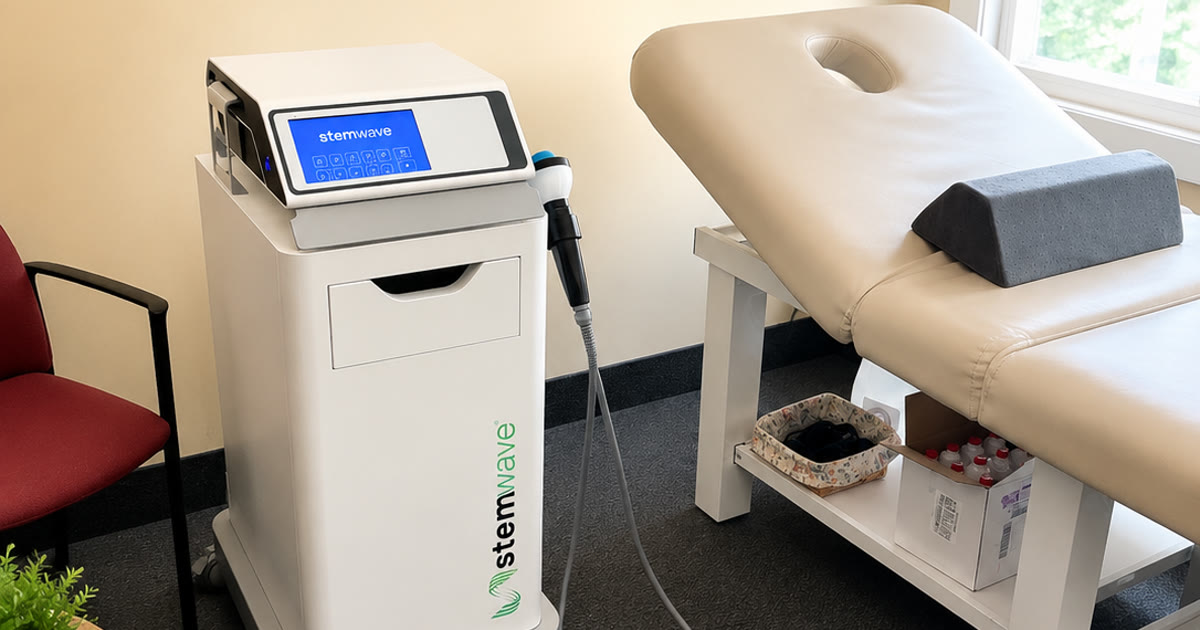
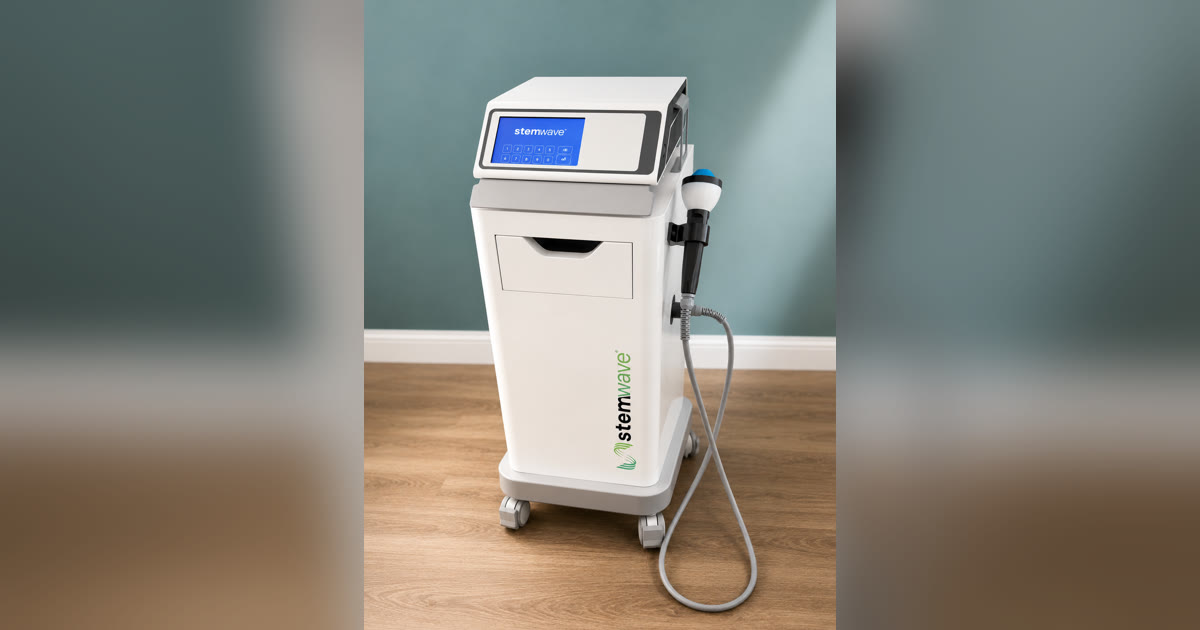
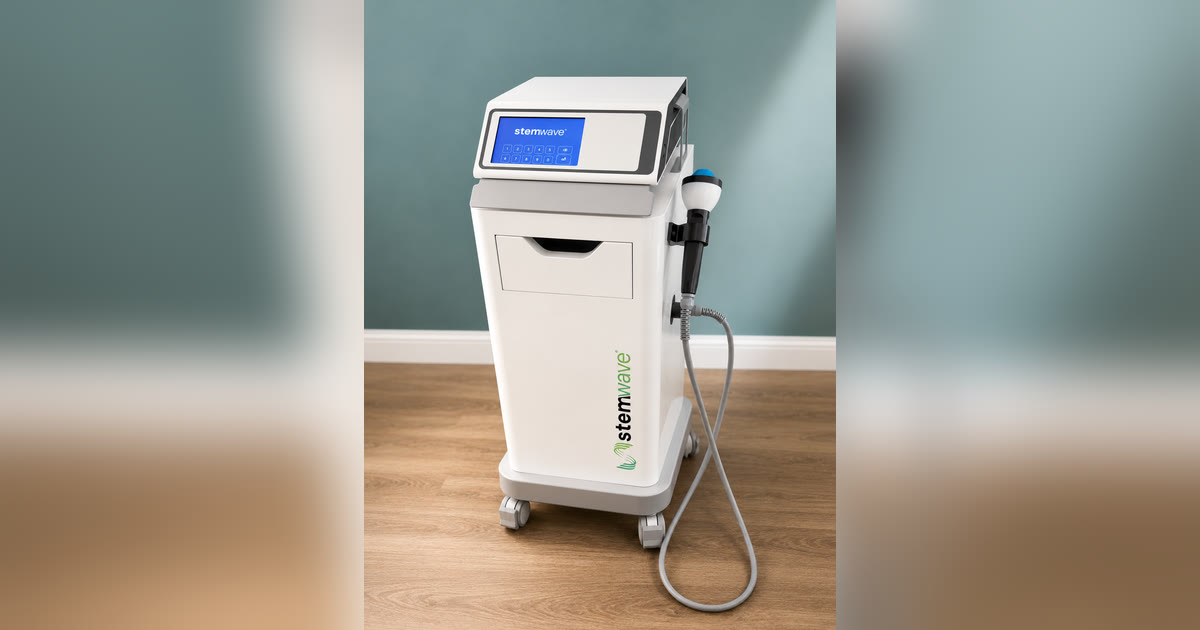
Acoustic wave therapy is a mechanical stimulus bet. Rather than quieting the tissue, the StemWave handpiece delivers rapid acoustic pressure waves into it. The working theory in the research literature is mechanotransduction: cells sense mechanical loading and respond with biological activity — increased local blood vessel formation, signaling through pathways like VEGF, and changes to the tendon's extracellular matrix. The device is designed to stimulate your body's own repair response rather than to mute the tissue.
This difference explains the timing pattern you are about to see. Suppressing a signal is fast. Prompting a repair response is not.
If you want the longer version of how the device works, I wrote that up separately in what StemWave therapy actually is.
What Cortisone Does Well — and We Should Say It Plainly
I am not going to pretend the injection doesn't work. It works, and in the short run it works better than what we do.
The cleanest illustration is a randomized controlled trial published in JAMA in 2013, which enrolled 165 adults with tennis elbow and randomly assigned them to a corticosteroid injection, a placebo injection, or either one combined with physiotherapy. At four weeks, the corticosteroid group was dramatically better off. Complete recovery or much improvement was reached by 71% of the corticosteroid-alone group versus 10% of the placebo-alone group — a relative risk of 7.32 (99% CI, 2.1–25.5).
That is not a marginal result. It explains why steroid injections have been standard practice for decades, and why a patient who gets one often walks out genuinely relieved. If you are in acute pain and need to function next week, that speed is a real clinical benefit and I would never dismiss it.
The problem is what the same trial found later.
The Part That Surprises People: The Curve Crosses
The JAMA researchers kept following those patients for a full year. Here is what happened to that enormous early advantage.
| Time point | Corticosteroid injection | Placebo injection |
|---|---|---|
| 4 weeks (alone, no physio) | 71% recovered / much improved | 10% |
| 26 weeks (pooled) | 55% | 85% |
| 52 weeks (pooled) | 83% | 96% |
| Recurrence over the year | 54% | 12% |
At one year, the corticosteroid patients had a lower rate of complete recovery than the placebo patients — 68 of 82 (83%) versus 78 of 81 (96%), a relative risk of 0.86 (99% CI, 0.75–0.99; P = .01). And recurrence, which the trial defined as recovering by four or eight weeks and then losing it, was 54% in the corticosteroid group versus 12% in the placebo group (RR 0.23; 99% CI, 0.10–0.51; P < .001).
Read those two rows again. The injection helped enormously at one month and was associated with poorer outcomes and far more relapse at one year — not compared to some rival treatment, but compared to a saline shot.
This is not one rogue study. A 2010 Lancet systematic review by the same group reached a similar conclusion across the tendinopathy literature: strong evidence of short-term benefit from corticosteroid injection, and worse outcomes than comparison treatments at intermediate and long-term follow-up.
One important correction, since this figure circulates widely online. You will see "72% recurrence with cortisone versus 8% with physiotherapy" attributed to that 2013 JAMA trial. It isn't from that trial — it appears in its introduction as a reference to earlier research, and the comparison was against physiotherapy, not placebo. The 2013 trial's own recurrence numbers are the 54% and 12% above. I'd rather give you the smaller, correct figure than the bigger, misattributed one.
The Head-to-Head Trials: Shockwave Therapy vs Cortisone Injection
Everything above compares cortisone to placebo. What happens when you compare it directly to shockwave?
A 2024 systematic review and meta-analysis in Orthopaedic Surgery pooled six randomized controlled trials that did exactly that in chronic tennis elbow. The pattern it found mirrors the timing story:
- At one month, shockwave was inferior to corticosteroid injection on pain scores.
- At three months and again at six months, shockwave was superior.
- Adverse events were mild and occurred at similar rates in both groups.
Both treatments are effective and safe, the authors concluded — shockwave simply trades short-term speed for longer-term gain.
A 2025 umbrella review in the Journal of Orthopaedics and Traumatology — a review of nine prior meta-analyses — reached a similar headline, reporting that pooled pain scores favored shockwave over corticosteroid injection (SMD 1.13; 95% CI, 0.72–1.55; P < 0.00001).
That is the case for shockwave, stated as strongly as the evidence honestly allows. Now the other half.
Where the Shockwave Evidence Is Weaker Than the Marketing
Here is what those same papers say that you will not find on most shockwave clinic websites.
The head-to-head comparison is graded as weak evidence. That 2025 umbrella review rated its own shockwave-versus-corticosteroid finding as evidence level IV — "weak evidence" — because it rests on a single underlying meta-analysis. A favorable pooled number built on a thin base is still a thin base.
Shockwave does not improve everything. The same umbrella review found that although shockwave beat placebo on grip strength, the improvement fell below the minimum clinically important difference for tennis elbow. It also found no clinically meaningful effect on elbow function scores. Pain relief is not the same thing as restored function, and the research does not currently support claiming both equally.
Much of the supporting evidence is against sham, not against cortisone. A 2024 meta-analysis in Frontiers in Medicine pooled 18 randomized trials and 1,351 patients with upper-limb tendonitis, and found shockwave improved pain at three months (mean difference −1.45; 95% CI, −2.46 to −0.45; GRADE: moderate) and shoulder function scores (mean difference 7.56; 95% CI, 3.69–11.43; GRADE: high). But it also found no significant grip-strength benefit (P = 0.10), and every trial in it compared shockwave to placebo — not to an injection. It cannot be used to claim superiority over cortisone, and I am not using it that way.
Heterogeneity is high and devices differ. Trials use different machines, energy levels, pulse counts, and session numbers. "Shockwave therapy" in a research paper is not automatically the same intervention as any one clinic's protocol.
Shockwave therapy may help chronic tendon pain, and the trend across the long-term data is genuinely encouraging. It is not proven to work for everyone, and anyone telling you otherwise is ahead of the evidence.
Side Effects: A Fair Comparison
Both are conservative options compared to surgery. Neither is free of downsides.
Corticosteroid injection. In that 2013 trial, adverse events were described as minor and transient. Two were specific to the steroid groups: skin depigmentation in 4 of 83 patients (5%) and subcutaneous atrophy in 3 of 83 (4%) — both appearing with delayed onset around 8 to 12 weeks, and both resolved by 26 weeks. The larger concern in the literature isn't a side effect at all; it's the long-term outcome and recurrence pattern described above.
Shockwave therapy. Across those 18 pooled trials, the authors reported that no serious long-term adverse effects were reported in any of the included studies. Some trials noted temporary increases in pain, and local reactions such as swelling, redness, or small bruises, which resolved by the end of treatment. A small number of patients could not tolerate treatment or withdrew. There are no needles and no medication involved. If you're wondering what the sessions themselves feel like, I covered that in does StemWave therapy hurt.
This Is Not an Either/Or Decision
Here is the framing I actually use with patients.
If you are in severe pain right now, cannot sleep, and have something next week you cannot miss, the speed of an injection is a legitimate advantage. That is a conversation for you and your physician, and nothing here is a reason to turn down care your doctor recommends.
If your pain has been going on for months, if you have already had one or two injections and the relief keeps getting shorter, or if you want to avoid a repeat steroid cycle, the longer-term data is the part worth weighing. That is the situation where most of my StemWave patients arrive.
And in most cases the real work is not the choice between the two. It's the loading. The strongest predictor in this literature is not which passive treatment you pick but whether the tendon gets progressively and appropriately loaded afterward — which is why we pair acoustic wave sessions with an actual rehabilitation plan rather than selling sessions on their own. I made the same point when writing about how many StemWave sessions people actually need: the session count matters less than what happens between sessions.
Shockwave Therapy in Bowie, MD: How We Handle This Conversation
At Total Wellness Chiropractic on Laurel Bowie Road, patients drive in from across Prince George's County — Bowie, Crofton, Mitchellville, Glenn Dale, Upper Marlboro, Lanham and Largo — usually after months of a shoulder, elbow, knee or heel that has not settled down.
What we do first is not book you for a course of sessions. It's examine the area, find out what has already been tried, and tell you honestly whether this is a reasonable candidate for acoustic wave therapy or whether you'd be better served by imaging, a referral, or simply a better loading program. Some people who ask about StemWave leave with a rehabilitation plan and no sessions at all — not every painful tendon in Prince George's County needs a device pointed at it. You can read more about the conditions we commonly see.
If it is a fit, the $50 first session gives you a real sense of the treatment before committing to anything longer. We don't quote a price for a course of care until we've examined you, because the honest answer depends on what we find.
Frequently Asked Questions
Is shockwave therapy better than a cortisone shot?
It depends entirely on the time frame. Trials consistently show corticosteroid injection performing better in the first month, and shockwave performing better at three and six months — a 2024 meta-analysis of six head-to-head randomized trials found exactly that pattern. Independent reviewers rate the direct comparison as weak-quality evidence, so "better" is a trend in the research, not a guarantee for any individual.
Can I have StemWave if I have already had a cortisone injection?
In many cases yes, and it is a common reason people come in — the injections helped less each time. We'd want to know what you were given, where, and how long ago, and we'd coordinate with the physician who gave it.
Does shockwave therapy have the same long-term risk as repeated steroid injections?
They aren't comparable risks. The concern with repeated corticosteroid injection in the literature is the pattern of higher recurrence and poorer one-year outcomes. Across 18 pooled randomized trials of shockwave, no serious long-term adverse effects were reported, though temporary soreness and local skin reactions do occur.
How quickly would I notice anything from StemWave?
Slower than an injection — that is the honest trade-off. The comparisons that favor shockwave are at the three- and six-month marks, not the one-month mark. Look for a trend over a few weeks, not overnight relief.
What conditions is this used for?
The strongest evidence base is in chronic tendon problems — tennis and golfer's elbow, rotator cuff and shoulder pain, Achilles tendinopathy, and plantar fascia pain. I wrote a dedicated piece on StemWave for plantar fasciitis if that's your issue.
Is StemWave covered by insurance?
Usually not. Shockwave therapy is generally not an insurance-covered service, which is part of why we offer a $50 first session — so you can evaluate it without a large commitment.
Talk It Through With Someone Who Will Give You Both Sides
If you're weighing shockwave therapy vs cortisone injection for a problem that has dragged on, come in and let's look at it properly. You'll get a straight assessment — including "this isn't the right tool for you" if that is the answer.
Total Wellness Chiropractic 6000 Laurel Bowie Road, Suite 202, Bowie, MD 20715 Phone: (301) 352-3454 Book an appointment · Learn more about StemWave
This article is for educational purposes only and is not medical advice, a diagnosis, or a treatment recommendation for any individual. StemWave acoustic wave therapy is not a cure for any condition, and individual results vary. Nothing here should be used as a reason to decline or discontinue care recommended by your physician. Always consult a qualified healthcare provider about your specific situation.
Sources
- Coombes BK, Bisset L, Brooks P, Khan A, Vicenzino B. Effect of Corticosteroid Injection, Physiotherapy, or Both on Clinical Outcomes in Patients With Unilateral Lateral Epicondylalgia: A Randomized Controlled Trial. JAMA. 2013;309(5):461–469.
- Coombes BK, Bisset L, Vicenzino B. Efficacy and safety of corticosteroid injections and other injections for management of tendinopathy: a systematic review of randomised controlled trials. The Lancet. 2010.
- Zhang L, Zhang X, Pang L, Wang Z, Jiang J. Extracorporeal Shock Wave Therapy Versus Local Corticosteroid Injection for Chronic Lateral Epicondylitis: A Systematic Review with Meta-Analysis of Randomized Controlled Trials. Orthopaedic Surgery. 2024;16(11):2598–2607.
- Zhu P, Tang P, Su J, et al. Comparison of extracorporeal shockwave therapy, ultrasound therapy, and corticosteroid injections for treatment of lateral epicondylitis: an umbrella review of meta-analyses. Journal of Orthopaedics and Traumatology. 2025;26(1):55.
- Xiong Y, Wen T, Jin S, et al. Efficacy and safety of extracorporeal shock wave therapy for upper limb tendonitis: a systematic review and meta-analysis of randomized controlled trials. Frontiers in Medicine. 2024;11:1394268.
- Biological response of extracorporeal shock wave therapy to tendinopathy in vivo (review). Frontiers in Veterinary Science. 2022;9:851894.