It is the first question almost everyone asks, and usually not in a full sentence. Someone is sitting on the table, we have just finished going over their shoulder, I mention StemWave, and there is a pause. Then: "Okay — but does it hurt?"
I appreciate the question, because it is the honest one. People have been told a machine is going to send acoustic waves into the exact part of their body that has been screaming at them for eight months, and they would like to know what they are signing up for. Fair.
So here is the straight answer, without the marketing gloss.
Does StemWave Therapy Hurt? The Short Answer
StemWave therapy is uncomfortable, not painful, for most people — and the discomfort is brief, adjustable, and over the moment the handpiece lifts off your skin.
That is the honest version. Not "it's completely painless," which is what you will read on a lot of websites and which would be a lie the first time I put the applicator on an angry tendon. And not "brace yourself," either, because that is not what happens in the room. It sits in between, and where exactly it sits depends on which body part we are working on, how irritated the tissue is, and how we set the intensity.
The more useful answer is a description of what actually happens minute by minute, so that nothing in the session is a surprise. That is most of what follows.
What a StemWave Session Actually Feels Like
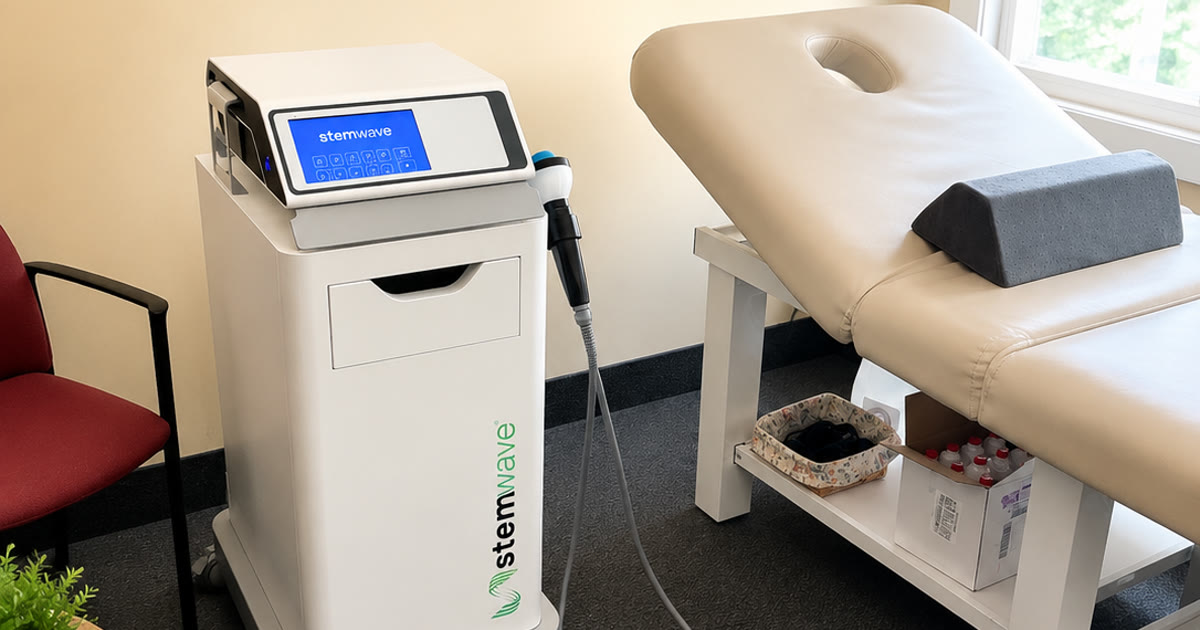
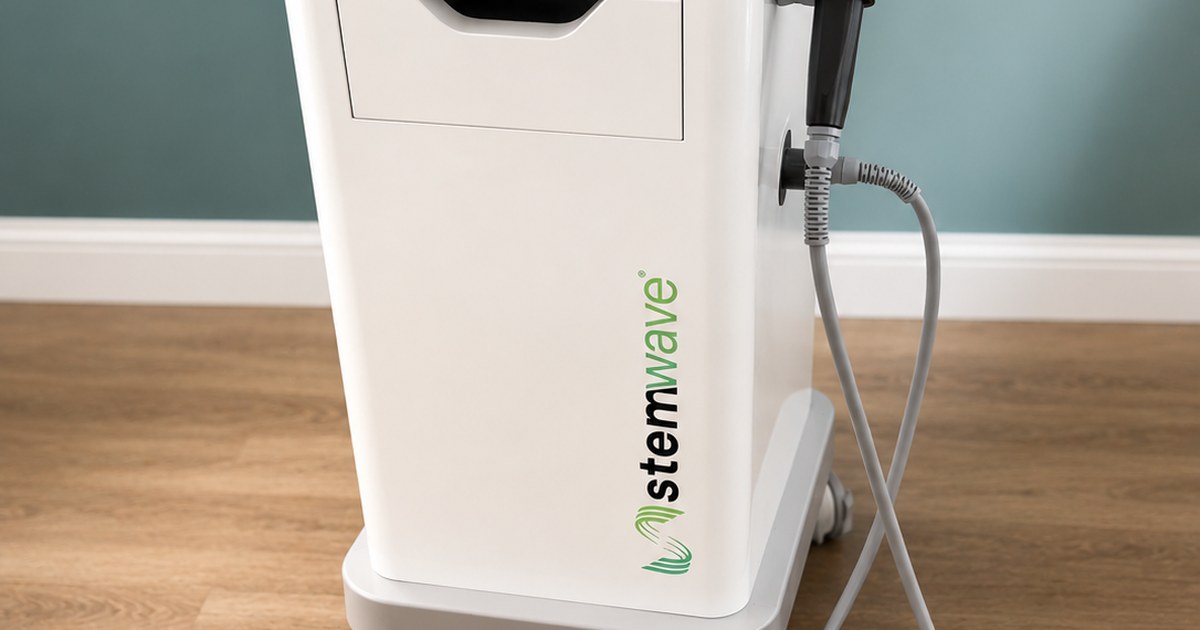
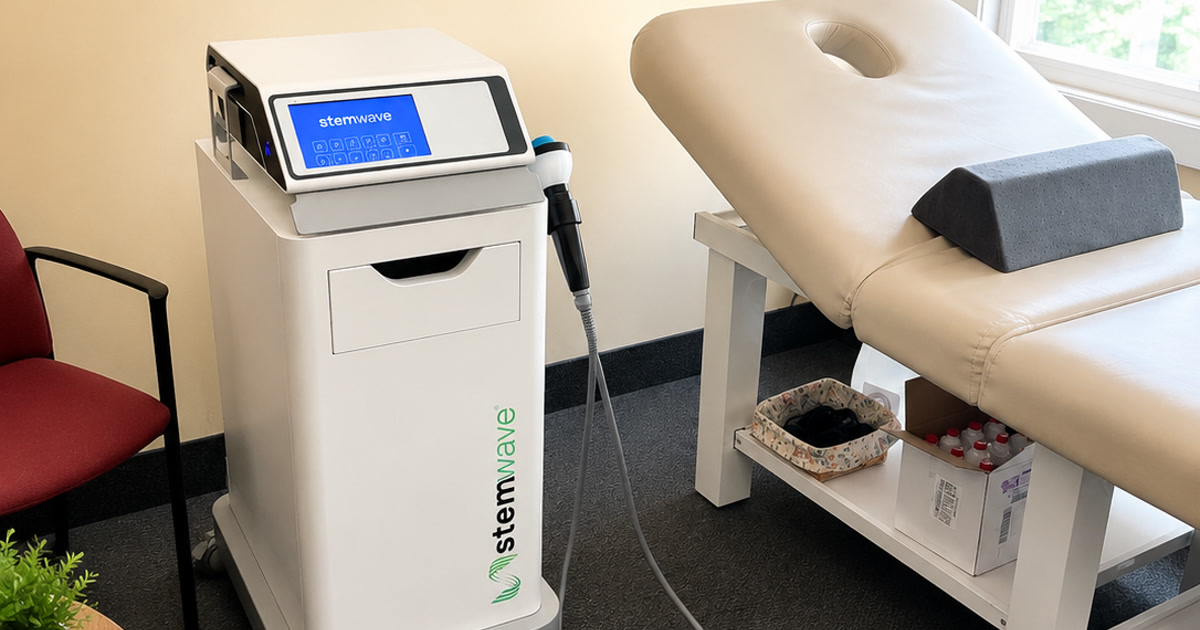
StemWave is an acoustic wave device. It delivers rapid pressure waves into soft tissue through a handpiece that stays in contact with your skin, with a layer of gel in between — same idea as an ultrasound, in terms of how the head glides. It is designed to stimulate your body's natural healing response in tissue that has stalled out and stopped remodeling on its own.
Mechanically, you are feeling repeated pulses of pressure. Not heat. Not electricity. Not a needle. Pressure, delivered fast.
The first few seconds
The handpiece touches down and starts pulsing. The most common description I hear is a rapid tapping, like someone flicking you with a fingertip very quickly, or a small rubber band snapping against the skin over and over. There is a knocking sound to go with it, which surprises people more than the sensation does. On healthy tissue away from the problem area, that is genuinely all it is. Odd, a little buzzy, not distressing.
Over the sore spot
This is the part worth being straightforward about. When the applicator moves directly over the irritated tissue — the tendon, the fascia, the trigger point that has been the whole problem — the sensation changes character. It goes from tapping to a deep, dull, bruise-like ache. Some people describe it as the machine "finding" the exact spot, which is a reasonable way to put it, because it does tend to light up the precise area you would have pointed to.
That is the peak of it. It is a strong sensation. It is also the part that lasts the shortest amount of time, because we are not parked on one square inch for ten minutes — we work through and around the area.
The rest of the session
A typical treatment area takes only a few minutes. You are on the table, clothed except for access to the region we are working on, and we are talking the entire time. Most patients are startled by how quickly it is done. The anticipation reliably outlasts the procedure.
Why the Sore Spot Is the Part That Hurts
There is a logic to this that helps people tolerate it much better once they understand it.
Tissue that has been chronically irritated is already sensitized. The area is more reactive to pressure than the tissue next to it — that is why you can find it with your thumb, and why you have been avoiding pressing on it for months. Introducing rapid mechanical pressure into an already-sensitized area is going to register more than the same pressure delivered an inch away over normal tissue.
So the discomfort is not a sign that something is going wrong. It is largely a reflection of where the problem is. Patients who come in for a second area on a later visit are often surprised that the new spot barely registers by comparison — because that tissue is not sensitized.
Something else worth knowing: for most people, session one is the most uncomfortable session. As the tissue changes and the sensitivity comes down, the same settings feel milder. I have had patients ask me at visit four whether I turned the machine down. Usually I have turned it up.
What the Research Says About Discomfort
I want to be careful here, because this is an area where it is easy to oversell.
A 2026 systematic review and meta-analysis in Scientific Reports pooled nine trials covering 530 patients with upper- and lower-limb tendinopathy, comparing radial and focused shockwave delivery. On the question of comfort, the authors state plainly that low-energy shockwave therapy "is generally well tolerated," that "discomfort during impulse application is usually mild," and that consequently "anesthesia is not required, and treatment can be repeated." Across all nine trials and all 530 patients, none required anesthesia.
The review also found no statistically significant difference in the proportion of patients who reported pain during treatment between the two delivery types, and no significant difference in adverse effects between them. The side effects that did appear in the literature were transient and minor: small skin petechiae, minor swelling, skin redness, and bruising, with isolated reports of fainting and migraine.
Two honest caveats, because you deserve them. First, the authors themselves rate the certainty of this evidence as low and describe their findings as exploratory rather than definitive — that is their language, not a hedge I am adding. Second, this review measured whether patients reported pain, not how intense that pain was on a scale. So it supports "discomfort is usually mild and manageable without numbing." It does not support anyone quoting you a precise number out of ten, and you should be a little suspicious of any clinic that does, because that number is not coming from this literature.
There is one more finding worth mentioning, mostly because it is counterintuitive. In studies of higher-energy shockwave where local anesthetic was used, numbing the area has been associated with worse outcomes, not better. The working theory is that the sensory response is part of how the treatment does what it does. Which reframes the discomfort a bit: it is not an unfortunate side effect of the therapy that we would eliminate if we could. It may be part of the mechanism.
How We Keep It Tolerable
This is the part that matters more than any statistic, because it is the part that is actually within our control in the room.
The intensity is a dial, and you control it. The device runs across a range of energy settings. We do not pick a number off a chart and grind through it. We start low, come up gradually, and stop climbing when you tell us we are at the edge of what is comfortable. There is no version of this where you are expected to endure something and stay quiet about it.
You get a calibration word. I ask patients to tell me when we hit about a seven out of ten in their own subjective terms — not because seven is a magic number, but because it gives us a shared language mid-session when talking gets harder. "That's a seven" is faster than describing a sensation.
We move. Staying in one spot concentrates the sensation. Working through a region distributes it and is better for the tissue anyway.
Positioning does a lot. A relaxed, well-supported limb tolerates the treatment noticeably better than a braced, guarding one. Half the job is getting you set up so you are not holding tension against the machine.
We can stop. At any point, for any reason. Nobody has ever had to justify it.
What You Might Feel Afterward
Immediately after, most people feel a warm, buzzy looseness in the area, and a fair number notice the original pain is temporarily quieter. That early relief is real but not the point — it comes and goes over the first day or two.
Over the following 24 to 48 hours, you may feel mild soreness in the treated area, similar to the day after a deep tissue massage or a workout you were not quite ready for. This is the most common after-effect and it is not a complication. Some people get temporary redness where the handpiece was, and people who bruise easily or take blood thinners may see minor bruising.
What we ask of you afterward is simple: drink water, keep moving normally, and skip icing the area. Ice is the instinct, but the whole objective is an inflammatory and circulatory response in tissue that has gone quiet, and you do not want to suppress the thing you just paid to stimulate. Anti-inflammatories work against the same goal, so if you can reasonably avoid them for a day or two, do.
If soreness is significant enough to interfere with your day, tell us and we will adjust the settings next time. That is data, not a complaint.
How It Compares to the Alternatives
Context helps. When patients ask "does StemWave hurt," what they usually mean is "does it hurt more than the other things I have tried or been offered."
Compared to a cortisone injection: different kind of discomfort entirely. An injection is a brief sharp needle plus a pressure sensation as the medication goes in, sometimes followed by a well-known post-injection flare. StemWave has no needle and nothing is injected. Most patients who have had both describe the injection as sharper and shorter, and StemWave as duller and spread over a few minutes.
Compared to dry needling: StemWave is generally the milder of the two, and there is no needle involved.
Compared to a deep tissue massage or aggressive soft tissue work on a chronically sore area: honestly, quite similar in character. Deep, achy, "hurts good" in places, genuinely uncomfortable directly over the worst spot.
Compared to the pain you already have: this is the comparison that decides it for most people. A few minutes of tolerable discomfort against months of a heel you cannot step on in the morning, or a shoulder that wakes you up when you roll onto it, is a trade the overwhelming majority of patients make without much hesitation.
Who Should Not Have StemWave
Tolerance is not the only question. Some people should not have acoustic wave therapy at all, or not over a particular area, regardless of how well they would handle the sensation. We screen for this at the first visit.
Shockwave should not be applied over a malignancy, over an active infection, over lung tissue, or in the field of a pacemaker or implanted defibrillator. It is not used over the abdomen or pelvis during pregnancy. Significant clotting disorders and blood thinners require a conversation before we proceed — not always a disqualification, but always a discussion, and that includes daily aspirin. Open wounds and areas of acute injury are also off the table.
This is exactly why the first visit is an examination and not just a treatment. Tell us your full medication list and history, including the things that seem unrelated. That is how we make sure the therapy is appropriate before we ever pick up the handpiece.
Pain Tolerance Is Not a Character Test
One last thing, and I mean it.
I see people try to white-knuckle their way through a session because they think flinching means something about them. It does not. Pain tolerance varies enormously between people for reasons that have nothing to do with toughness — nerve density, sleep, stress, medications, how long the area has been irritated, and what your nervous system has learned to expect from that body part after months of guarding it.
A patient who says "that's plenty" at a lower setting is not getting an inferior treatment. They are getting a correctly calibrated one. We would rather run a comfortable session that you come back for than an aggressive one that makes you cancel next week. Consistency across a course of care matters far more than intensity in any single visit.
Frequently Asked Questions
Does StemWave therapy hurt more than it helps?
For the large majority of patients, no — and the arithmetic is not close. The discomfort is minutes long and ends when the session does. That said, StemWave is not appropriate for everyone or every condition, and if it is not a reasonable fit for your problem we will tell you that at the exam rather than sell you a package.
Do you use numbing cream or anesthesia?
No, and that is standard practice for this kind of low-to-medium energy acoustic wave therapy rather than us being stingy. The research above found that across nine trials and 530 patients, none required anesthesia — and in higher-energy studies, numbing the area was associated with worse results. Adjusting the intensity is the better tool.
How long does a session take?
The acoustic wave portion of a treatment area typically runs only a few minutes. Plan on a short visit overall. Your first appointment takes longer because it includes an examination.
Will I be sore afterward? Can I work out?
Mild soreness for a day or two is common and expected. You can usually continue normal activity and training with sensible modification — most people do. What I would avoid is a sudden spike in load in the days right after a session, especially once the area starts feeling better and the temptation arrives.
Does it hurt more in certain body parts?
Yes. Areas with less soft tissue padding over bone — the heel, the elbow, the front of the knee, the shin — tend to register more than fleshier regions like the hip or glute. We adjust the settings by region and by person, not by protocol.
What if I have a low pain tolerance?
Then say so at the start and we will begin lower. This is a genuinely common conversation and it changes nothing about whether you are a candidate. See our conditions page for what we work with, or just call and ask.
How much does it cost to try?
The first session is $50. That lets you find out what it actually feels like on your own body rather than deciding based on an article — including this one. Payment options for continued care are on our financing page.
Is this the same as the shockwave therapy for plantar fasciitis I've read about?
Same underlying technology, applied to a different area. If heel pain is your issue, we wrote about StemWave for plantar fasciitis in more depth. For the general overview of the technology, start with what StemWave therapy is.
Finding Out for Yourself in Bowie
There is a limit to how much a written description can tell you about a physical sensation. You now know more than most people do walking in — the tapping, the deep ache over the bad spot, the few minutes, the mild soreness after — but your own tolerance on your own tissue is something you can only find out by trying it.
If you have a tendon, a heel, a shoulder, or a stubborn area that has not responded to rest and time, come get it examined. We will tell you whether StemWave is a sensible option for your specific problem, and we will tell you plainly if it is not. We see patients from Bowie, Crofton, Mitchellville, Glenn Dale, Lanham, Largo, Upper Marlboro and across Prince George's County.
Total Wellness Chiropractic 6000 Laurel Bowie Road, Suite 202, Bowie, MD 20715 (301) 352-3454 Book an appointment · Contact us · See all services
StemWave first session: $50.
This article is for educational purposes and is not medical advice. StemWave uses acoustic wave technology designed to stimulate the body's natural healing response; it is not a cure for any condition, and individual results may vary. Descriptions of sensation are typical patient reports and your experience may differ. Talk with a qualified healthcare provider about your specific condition, medications and history before beginning any new treatment.
Source: Stania M, et al. "Efficacy of radial and focused shockwave therapy for tendinopathy: a systematic review and meta-analysis." Scientific Reports, 2026. PMC12936064