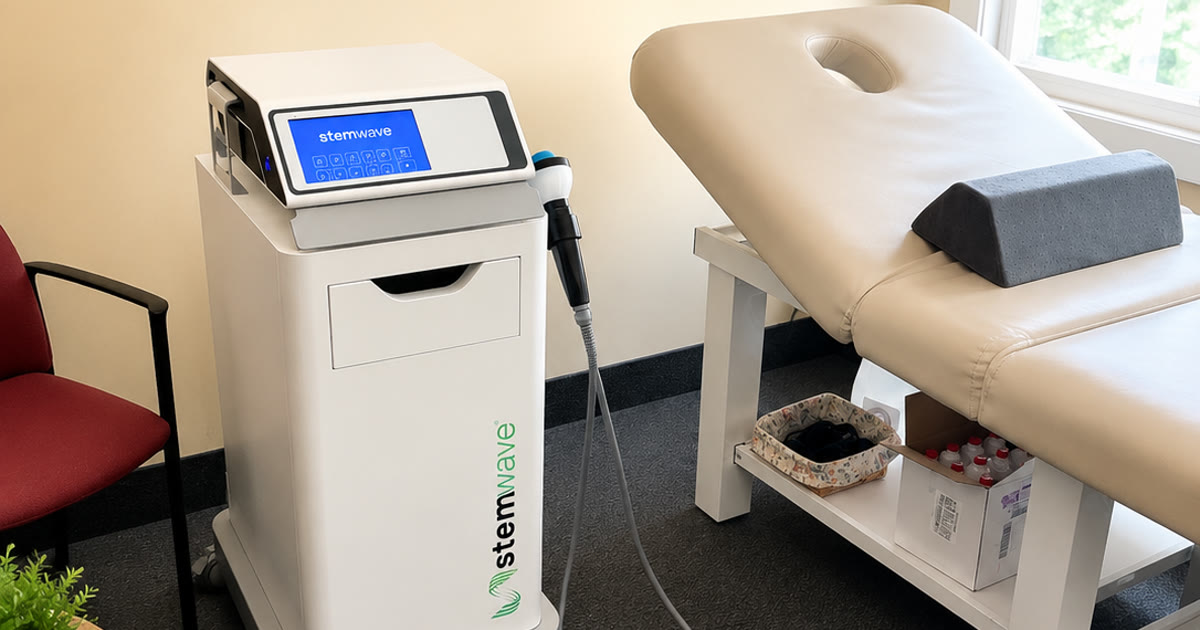
There is a question people ask before they ask about the price, before they ask whether it hurts, and sometimes before they even sit down. They want to know what they are signing up for. Not the marketing version — the calendar version. How many trips to Bowie is this? How many Thursdays?
So let's answer it properly.
How Many StemWave Sessions Do I Need? The Short Answer
Most people ask "how many StemWave sessions do I need" expecting one number, and the most defensible answer for a typical stubborn tendon or fascia problem is three to six sessions, spaced about a week apart. That is the range I quote in the office, and it is the range the shockwave research keeps landing on.
But that range hides something important, and the honest version is worth two extra minutes of your time: the number is not decided in advance. It is decided by how your tissue responds after session two and session three. Anyone who tells you the exact count before they have put a handpiece on the sore spot is guessing — politely, but guessing.
Where the "Three Sessions" Number Comes From
It is not a marketing figure. It comes out of the literature.
The largest systematic review of shockwave therapy protocols pulled 106 randomized trials out of the PEDro database and looked specifically at how the treatment was dosed — sessions, intervals, impulses, energy. Its conclusion was that the optimum protocol appears to be three sessions at one-week intervals, using 2,000 impulses per session at the highest energy the patient can comfortably tolerate.
That is Schmitz and colleagues in the British Medical Bulletin (2015;116(1):115–138), and it is still the finding most clinicians build their protocols around.
The same review reported something that matters just as much: across all those trials, the average number of sessions was 2.88 — with a range from 1 to 12. Three is the center of a wide distribution, not a rule.
You will find that three-session rhythm outside the journals too. When NPR covered shockwave therapy for heel and elbow pain in March 2026, Stanford physiatrist Dr. Raymond Chou described his protocol in one sentence: "It's delivered once a week for three weeks," with each session running about five to ten minutes. The patient in that story felt improvement within a week or two of the first treatment.
Why the Range Is 1 to 12, Not a Single Number
Different tissues, different depths, different protocols. Here is roughly how the published trials have dosed some of the conditions we see most often in the office:
| Condition | Typical session count in published trials | Interval |
|---|---|---|
| Plantar fasciitis / heel pain | 3–4 | Weekly |
| Insertional Achilles tendinopathy | 3 | 5–10 days |
| Lateral epicondylitis (tennis elbow) | 3 | Weekly |
| Non-calcific supraspinatus tendinopathy | 2 | 7 days |
| Degenerative rotator cuff tendinopathy | 6 | Weekly |
| Calcific shoulder tendinopathy | 8–12 | 1–2 per week |
A calcium deposit sitting inside a shoulder tendon is a fundamentally different job than a shallow band of irritated fascia under the heel. It is not surprising that it takes more passes.
That table is a map of what researchers have tried, not a promise about what you will need. But it explains why "three to six" is an honest range rather than a hedge.

Five Things That Actually Change Your Session Count
When I look at a new case, these are the variables that push the number up or down.
1. How long you have had it
A heel that has hurt for six weeks and a heel that has hurt for three years are not the same tissue. Longer-standing problems have usually accumulated more disorganized collagen and fewer blood vessels, and they generally need more input before anything shifts. Chronicity is the single biggest driver of session count in my experience.
2. How deep the target is
Fascia under the heel is close to the surface. A gluteal tendon at the hip, or a rotator cuff under a layer of deltoid, sits considerably deeper. Depth affects how much of the acoustic energy actually reaches the tissue you care about, which affects how many passes it takes.
3. Whether there is calcification
Calcific tendinopathy of the shoulder is the outlier in every dosing table, and it is the one condition where you should expect the higher end — or beyond it.
4. What you do between sessions
This is the one patients underrate, and I will come back to it below, because there is a trial that makes the point better than I can.
5. How you respond after sessions two and three
By the third visit I usually have a read. If the morning pain has dropped, if the sore spot has moved or shrunk, if you are getting through a workday differently — that is a tissue that is responding, and the plan usually finishes on schedule. If nothing has changed at all by session three, adding sessions four through eight is rarely the right answer. Re-examining the diagnosis is.
What the Schedule Actually Looks Like
For a typical plan at our Bowie office:
- Sessions are about 5–15 minutes of actual treatment time, inside a visit that runs longer because we reassess each time.
- Spacing is roughly weekly. The interval is not arbitrary — the acoustic waves are designed to stimulate a repair response, and that response needs days to play out before the next round is useful.
- There is no downtime. One of the reasons shockwave appeals to active people is that there is minimal activity restriction afterward, unlike surgery or an injection. Mayo Clinic sports medicine specialist Dr. Joshua Romero made exactly this point in that NPR piece: it lets people "maintain their sport or active lifestyle while still getting treatment."
- You may be sore for a day or two after a session. That is common and usually brief — we cover this in detail in our post on what StemWave actually feels like.
Sessions Are Not the Only Variable
Here is the study I think every patient considering shockwave should know about, precisely because it is not a flattering one.
In 2025, a randomized controlled trial published in Clinical Rehabilitation assigned 76 people with insertional Achilles tendinopathy to receive either three sessions of radial shockwave therapy or a sham treatment. Crucially, both groups also did the same structured calf-loading exercise program and education. The authors concluded that adding shockwave to that exercise and education program did not improve pain, function or any other outcome compared with sham at either six or twelve weeks (Alsulaimani et al., Clinical Rehabilitation, 2025).
Two things are worth pulling out of that. First, both groups got substantially better — average function scores climbed from the mid-40s to the mid-60s over twelve weeks. The exercise program was doing real work. Second, in that particular condition, with that particular protocol, the shockwave did not add a measurable amount on top of it.
I include this because the useful lesson is not "shockwave doesn't work." The evidence base is mixed by condition, and reviews continue to find positive results for plantar fasciopathy and lateral epicondylitis in particular. The useful lesson is that the number of sessions is not the lever people think it is. What you do in the six days between sessions — the loading, the stretching, the footwear, the mechanics we correct on the table — is not a supporting actor. In at least one well-run trial, it was the whole show.
That same trial found no serious adverse events, which is consistent with the safety record across the literature. Minor soreness after a session was the common complaint.
How We Decide You Are Done
There is no scan that says "finished." We use three things:
- Your function, not your pain score. Can you do the first ten minutes of the morning without limping? Can you carry groceries up the stairs? Function is the better signal.
- The tenderness map. We mark and re-check the same spot each visit. A shrinking or migrating tender point is a real change.
- The trajectory. Improvement from acoustic wave therapy is typically gradual and often continues for weeks after the final session, because tendon and fascia remodel slowly. That means the right move at the end of a plan is frequently to stop and wait six weeks, not to book four more sessions.
If you have plateaued and stayed plateaued, more sessions are not the answer. We would rather re-examine, image if appropriate, or send you to the right specialist than sell you visits that are not moving anything.
Shockwave Therapy in Bowie, MD: How We Structure the Plan
We see patients from across Prince George's County — Bowie, Mitchellville, Crofton, Glenn Dale, Lanham, Upper Marlboro and Largo — and most of them arrive having already tried rest, ice, stretching, orthotics, and a round of anti-inflammatories.
Our approach is deliberately staged:
- Session one is $50, and it is a real session, not a consultation. You get examined, we identify and mark the target, and you get treated.
- We reassess at every visit. No one is handed a twelve-session package on day one.
- Shockwave is rarely the only thing we do. It sits alongside chiropractic adjustment and the rest of our services, because a heel or a shoulder that keeps re-irritating usually has something upstream driving it — which is the same reason back pain keeps coming back when only the painful spot gets treated.
You can read more about the technology on our StemWave page, see the conditions we work with, or read what StemWave therapy is and how it applies to plantar fasciitis specifically.
One practical note: shockwave therapy is not typically covered by most insurance plans, which is why we price the first session the way we do — so you can find out how your body responds before committing to anything.
Frequently Asked Questions
How many StemWave sessions do I need for plantar fasciitis?
Published shockwave trials for heel pain most often used three to four sessions at weekly intervals. That is a reasonable starting expectation, but your count depends on how long you have had it and how you respond by the third visit.
How far apart should StemWave sessions be?
About a week. The most-cited protocol review recommends one-week intervals, and trials commonly use 5–10 days. The spacing gives the tissue response time to develop between rounds.
How soon will I notice something?
Some people notice a change within the first week or two. Others notice nothing until after the third session. Because tendon and fascia remodel slowly, improvement often keeps developing for weeks after the last visit — so the final read on a plan is usually taken six to eight weeks out, not on the day of the last session.
What if I do not improve after three sessions?
Then we stop and re-examine rather than adding sessions. No improvement at all by the third visit usually means the diagnosis needs another look, not that the dose was too small.
Can I keep exercising during a course of sessions?
Generally yes — there is minimal activity restriction after shockwave, which is one of its practical advantages. We will give you specific loading guidance, and based on the research, that guidance matters at least as much as the sessions themselves.
Is one session ever enough?
It happens, and the protocol reviews include single-session trials. It is not what I would plan around.
Ready to Find Out What Your Plan Looks Like
The only way to know how many sessions you need is to have someone examine the actual tissue and then watch how it responds. That is what the first visit is for.
Book your $50 first session at wherethehealingbegins.com or call (301) 352-3454. You will find us at Total Wellness Chiropractic, 6000 Laurel Bowie Road, Suite 202, Bowie, MD 20715 — a short drive from Crofton, Mitchellville, Glenn Dale, Lanham, Upper Marlboro and Largo.
This article is for educational purposes only and is not medical advice. StemWave is an acoustic wave technology designed to stimulate your body's natural healing response; individual responses vary, and no outcome is guaranteed. Nothing here should be used to diagnose or manage a condition on your own. If you have new, severe, or worsening symptoms — or any red-flag symptoms such as numbness, weakness, or loss of bowel or bladder control — seek prompt in-person evaluation. Please consult Dr. Schmitt or a qualified healthcare provider about your specific situation.