You know the exact moment I'm talking about. Your alarm goes off, you swing your legs out of bed, and the first step onto the floor feels like stepping on a nail. You limp to the bathroom. After ten or fifteen minutes it loosens up and you tell yourself it's fine. Then you sit through a meeting, stand back up, and it's the nail again.
That first-step pain is the signature of plantar fasciitis, and it is the single most common heel complaint I see at my office here in Bowie. Most of the people who end up in my treatment room have already done six months of the standard playbook — better shoes, a night splint, a frozen water bottle under the arch, maybe a cortisone shot that helped for a few weeks and then wore off.
If that's where you are, this article is for you. I want to walk you through StemWave for plantar fasciitis: what acoustic wave therapy actually does to a heel, what the published research on shockwave therapy shows, what a session in our office is like, and — just as important — who it isn't right for.
What StemWave for Plantar Fasciitis Actually Does
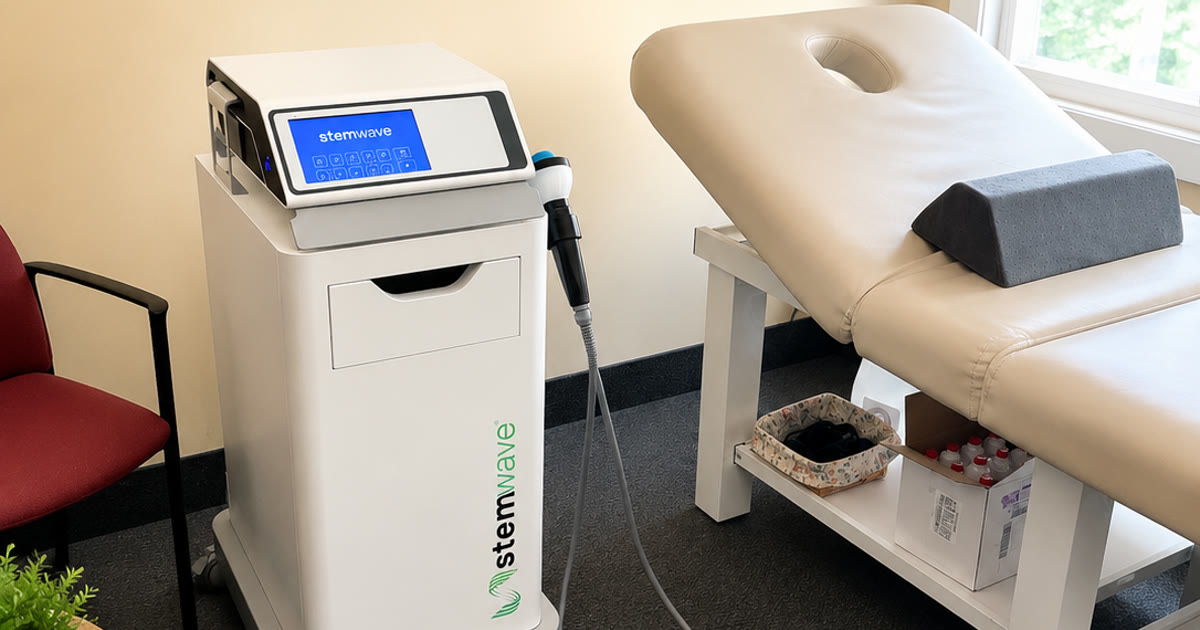
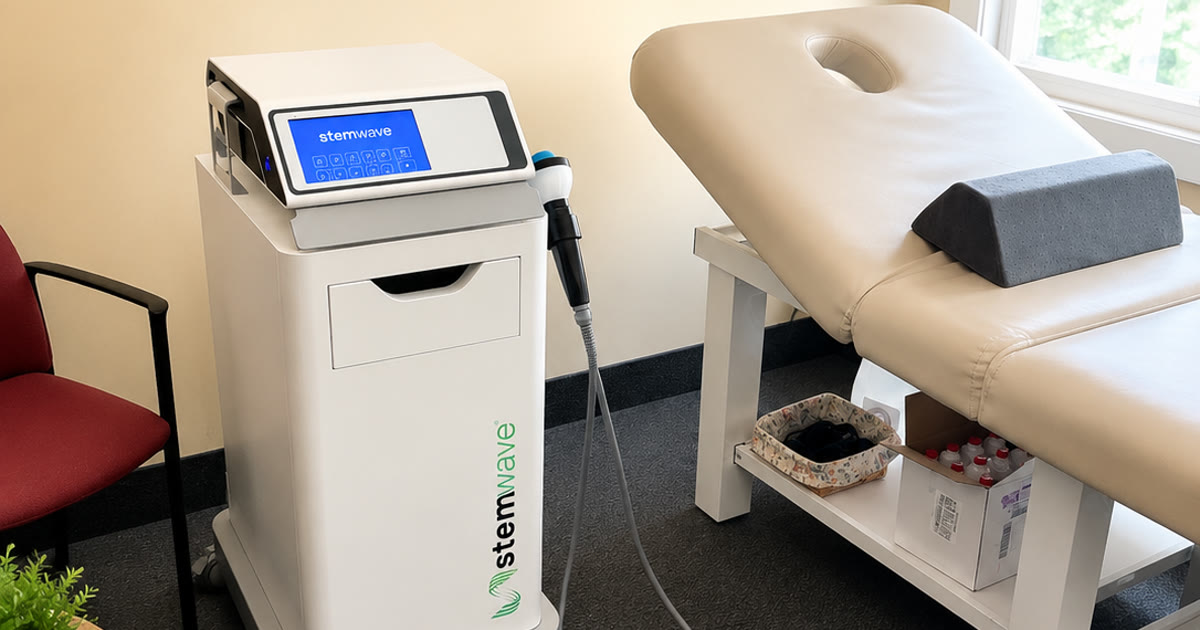
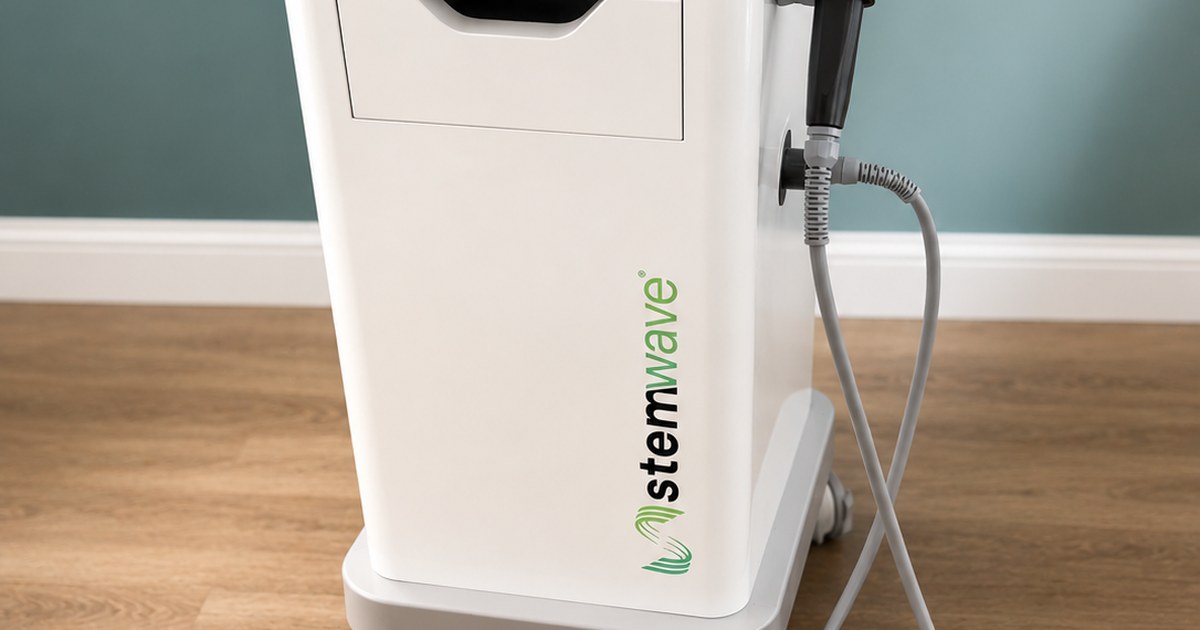
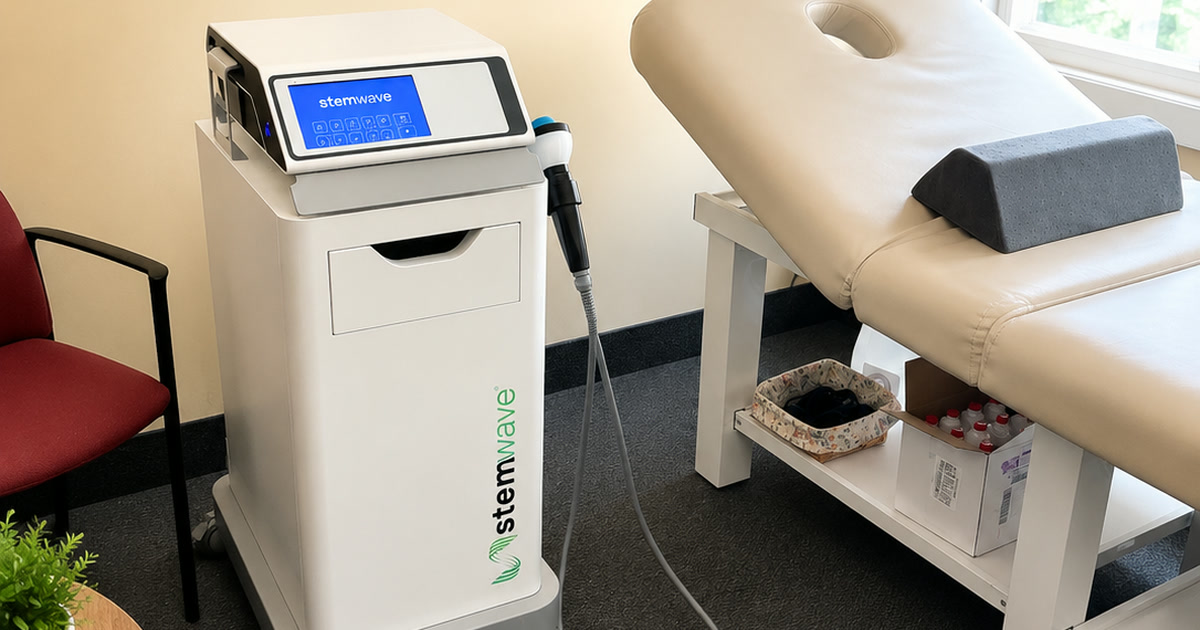
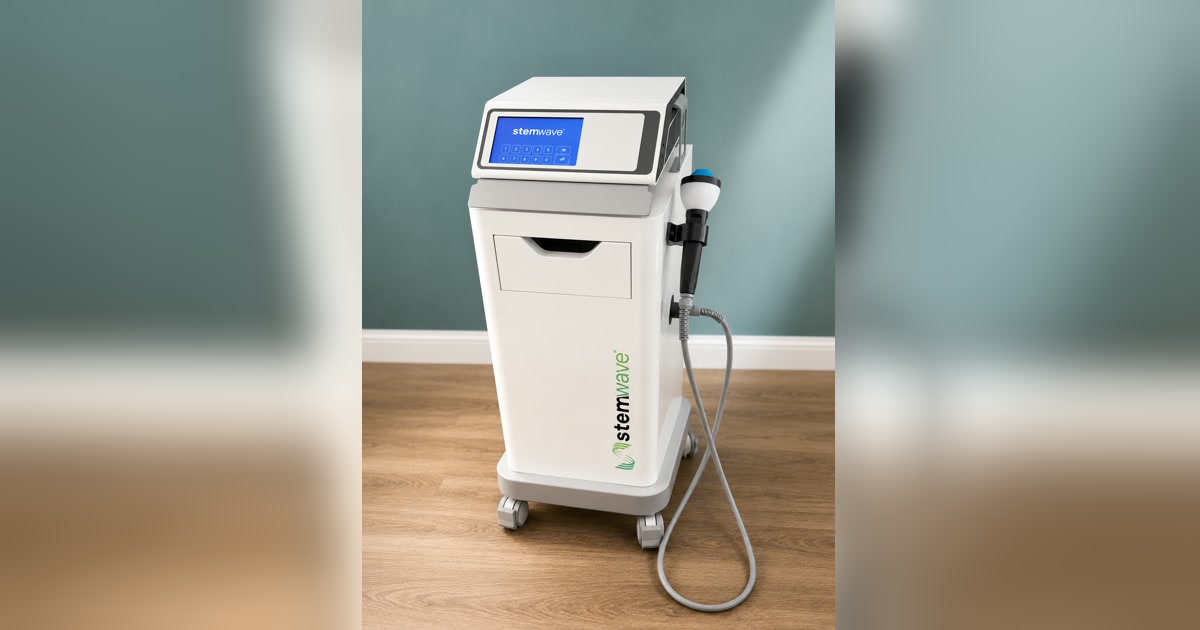
StemWave is an acoustic wave device — the same family of technology the medical literature calls extracorporeal shockwave therapy, or ESWT. "Extracorporeal" just means outside the body. Nothing is injected, nothing is cut, and no medication is involved. A handpiece is placed against the skin over the painful part of your heel and arch, and it delivers rapid pulses of acoustic energy into the tissue underneath.
The goal is not to numb the area. The goal is to change the biological environment of tissue that has stopped repairing itself.
That distinction matters more in the heel than almost anywhere else in the body, and to explain why, I have to correct something you have probably been told.
Plantar Fasciitis Is Not Really an Inflammation Problem
The name is misleading. The suffix "-itis" means inflammation, and that framing is why so much plantar fasciitis care is aimed at putting out a fire — ice, anti-inflammatories, cortisone.
But when researchers actually look at plantar fascia tissue from long-standing cases under a microscope, what they find is not a raging inflammatory response. The NIH's StatPearls review of plantar fasciitis describes it as primarily a degenerative process, with micro-tears, disorganized collagen, and granulation tissue — and a notable absence of the classic inflammatory cells you would expect from the name. Some clinicians now prefer the term plantar fasciosis or plantar fasciopathy for exactly this reason.
That reframing explains a lot of frustrating experiences:
- Why anti-inflammatories stop helping. If the tissue isn't primarily inflamed, suppressing inflammation addresses a symptom rather than the state of the tissue.
- Why rest alone often fails. Degenerated tissue with poor blood supply doesn't reliably reorganize itself just because you stayed off it. Fascia has a modest blood supply to begin with.
- Why it comes roaring back. You rest until it calms down, return to full activity, and land right back in the same tissue that never actually rebuilt.
It also explains why a therapy aimed at stimulating repair — rather than quieting inflammation — is a different kind of tool.
The same review notes plantar fasciitis affects roughly 10% of the general population at some point, accounts for about 10% of running injuries, and peaks between ages 40 and 60. If you feel like you're the only person hobbling to the coffee maker in the morning, you are emphatically not.
How Acoustic Waves Are Designed to Restart a Stalled Repair
When acoustic waves pass into the plantar fascia and the surrounding heel tissue, they create controlled mechanical stress at the cellular level. The body reads that stress as a signal that the area needs attention. Research on shockwave therapy describes several responses that this may support:
- New microvessel formation (angiogenesis). Better circulation into tissue that has been undernourished for months or years.
- Growth factor and repair-cell signaling. The mechanical stimulus is associated with the release of signaling molecules that recruit the body's own repair machinery to the area.
- Remodeling of degenerated tissue. Studies measuring plantar fascia thickness on ultrasound have tracked reductions in that thickness after a course of shockwave.
- Changes in local pain signaling. Patients frequently report the treated area simply becomes less reactive over the following weeks.
I want to be precise with my language here, because this is a field with a lot of overselling in it. StemWave is designed to stimulate your body's own healing response. It does not cure plantar fasciitis, it is not a guarantee, and any provider who tells you otherwise is selling rather than treating. What it may support is a better environment for the tissue to rebuild — while you also correct the loading problem that got you here.
What the Research on Shockwave Therapy for Heel Pain Shows
Shockwave therapy for plantar fasciitis has been studied more heavily than most conservative options, and the reviews are worth understanding — including their limits.
| Study | What it looked at | Reported findings |
|---|---|---|
| Cortés-Pérez et al., Clinical Rehabilitation, 2024 (PMID 38738305) | 16 randomized trials, 1,121 patients — shockwave vs. corticosteroid injection | At three and six months, shockwave outperformed corticosteroid injection on pain and foot function, with reduced plantar fascia thickness. Local pain and mild redness were the most common side effects. |
| Lippi et al., European Journal of Physical and Rehabilitation Medicine, 2024 (full text) | 11 randomized trials, focused on tolerability plus pain and function | Reported meaningful reductions in pain scores for both focused and radial shockwave, and found that treatment parameters — pulse count, energy, frequency — influenced both results and dropout. |
| Systematic review and meta-analysis, Frontiers in Immunology, 2023 (full text) | Shockwave across patellar tendinopathy, Achilles tendinopathy and plantar fasciitis | Examined shockwave's effect across the tendinopathy family, of which plantar fasciopathy is a close cousin. |
Three honest caveats before you read too much into that table:
- These studies are on shockwave therapy as a category, not on the StemWave device specifically. The mechanism is shared; the exact device, settings and protocol are not identical across trials.
- Parameters matter. The 2024 European review is explicit that how the therapy is delivered changes the outcome. That is an argument for having it done by someone who assesses you first, not for chasing the cheapest available session.
- Individual results vary. A heel that has hurt for eight years with a large bone spur and an untreated calf contracture is a different problem from a heel that has hurt for four months.
Shockwave Therapy in Bowie, MD: What a Session Actually Looks Like
Most of the plantar fasciitis patients I see at Total Wellness Chiropractic come to us from around Prince George's County — Bowie, Mitchellville, Glenn Dale, Lanham, Largo and Upper Marlboro — plus a steady stream from Crofton just across the Anne Arundel line. Almost all of them arrive having already spent money on shoes, inserts and at least one specialist visit.
Here is what the visit is:
First, an actual examination. Before anything is applied to your heel, I want to know where the pain lives, how your ankle dorsiflexes, what your calf and Achilles are doing, how your arch loads when you walk, and whether anything in the exam suggests this isn't plantar fasciitis. Heel pain can come from a calcaneal stress fracture, a fat pad problem, tarsal tunnel syndrome or a referred nerve issue from the low back — and none of those are helped by treating the fascia. Skipping this step is how people spend months on the wrong problem.
Then the treatment itself. Ultrasound gel goes on the heel, and the handpiece is worked over the painful region and along the fascia toward the arch. You will hear a rapid clicking and feel a deep tapping or thudding sensation. Most patients describe it as strange more than painful — intense right over the sorest spot, tolerable elsewhere, and adjustable. If it is too much, we turn it down. The treatment portion typically runs about 10 to 15 minutes.
Then you walk out. There is no downtime, no bandage, no anesthesia, nothing to wear off before you can drive. Some patients feel noticeably looser walking to the car; others feel a mild ache in the heel that evening, which is a normal response to the stimulus. You are not sidelined.
Our first session is $50, which is intentionally low, because the honest answer to "will this help me?" is that a proper exam plus a session tells us far more than another week of internet reading will.
How StemWave Compares to the Other Plantar Fasciitis Options
None of these are enemies. Most heels do best with a combination. But it helps to see what each option is actually for.
| Option | What it does | Trade-offs |
|---|---|---|
| Rest, ice, NSAIDs | Calms symptoms while you back off load | Addresses the symptom; degenerated tissue often unchanged when you resume activity |
| Stretching and calf/foot strengthening | Addresses the load and flexibility problem underneath | Essential, but slow, and often not enough alone in long-standing cases |
| Orthotics and supportive shoes | Redistributes load across the arch | Manages the mechanics; doesn't itself rebuild tissue |
| Night splints | Keeps the fascia from re-shortening overnight | Helps that first-step pain; tolerance varies |
| Corticosteroid injection | Powerful short-term symptom control | Effect commonly fades; repeat injections carry tissue concerns. The 2024 review above found shockwave compared favorably at three and six months |
| StemWave (acoustic wave therapy) | Designed to stimulate the body's own repair response in the tissue itself | Takes a series of sessions; not appropriate for everyone; results vary |
| Surgery (plantar fascia release) | Last-resort structural intervention | Real recovery time and real risk; reserved for cases that fail extended conservative care |
The way I frame it with patients: stretching and orthotics change how the tissue is loaded, and StemWave is aimed at the state of the tissue itself. Doing one without the other is why so many people plateau.
How Many Sessions Does It Take?
Shockwave is a course, not a single event. In the published protocols, patients typically receive a series of treatments spaced roughly a week apart, and the meaningful changes are measured at three and six months — not at day three.
In our office, I reassess after the first few sessions. If your first-step pain, your tolerance for standing, and your exam findings are all moving in the right direction, we continue. If after a reasonable trial nothing has changed, I will tell you that plainly and we will look at what else is going on, including a referral. Continuing to sell someone sessions that aren't working isn't care.
What I ask of patients during that window matters too: keep up the calf and plantar fascia loading work, don't go from zero to a 10K the week you start feeling better, and be honest with me about what your job actually demands of your feet.
Who Should Not Have Shockwave Therapy
This is the part most articles skip. Acoustic wave therapy is generally well tolerated — the reviews above list local soreness and mild redness as the usual side effects — but it isn't for everyone. We screen for, and generally do not treat:
- Pregnancy
- Active infection, open wounds or skin breakdown over the treatment area
- Known malignancy in the treatment area
- Bleeding disorders or use of blood-thinning medication (a conversation, not always a hard no)
- Certain implanted electronic devices, depending on placement
- Recent corticosteroid injection at the site — we typically allow a window before treating
- Growth plates still open in skeletally immature patients
And if your heel pain arrived suddenly after a specific injury, comes with numbness, tingling, or weakness spreading into the foot, or is accompanied by fever, redness and swelling that suggest infection, that needs medical evaluation before anyone treats a fascia. If you are unsure, MedlinePlus has a plain-language overview of heel pain worth reading, but a phone call to us or your physician is faster.
Frequently Asked Questions
Does StemWave for plantar fasciitis hurt?
Most patients describe a deep tapping sensation that is intense directly over the sore spot and tolerable elsewhere. The intensity is adjustable and we adjust it in real time. It is not comparable to an injection, and nothing numbing is required.
How soon might I notice a difference?
Some patients notice their morning first-step pain is less sharp within a couple of sessions. Others notice nothing for several weeks and then realize they have stopped thinking about their heel. The research measures outcomes at three and six months, which tells you something about the timescale of tissue change. Individual results vary.
Is shockwave therapy covered by insurance?
Coverage for shockwave therapy is inconsistent and frequently not covered for plantar fasciitis. We keep it straightforward instead: the first session is $50, and we will tell you what a course looks like before you commit to anything. See our financing page for payment options.
Can I keep running or working out?
Usually yes, with adjustment. I would rather modify your training than shut it down entirely — tissue responds to sensible load. What I don't want is a sudden spike in mileage the week the heel starts feeling better, which is the most reliable way to restart the whole cycle.
Can I combine StemWave with chiropractic care?
Yes, and often we should. A heel that has been limped on for a year changes how you load your hip, pelvis and low back. Treating the foot while ignoring what the rest of the chain has adopted around it leaves half the problem in place. If you want the broader picture of the technology first, start with what StemWave therapy is.
What if it turns out I don't have plantar fasciitis?
Then we find out at the exam, before you spend money on the wrong treatment. Several conditions imitate plantar fasciitis, and identifying them is part of the first visit. You can see the full range of what we work with on our conditions page.
Getting Your Heel Looked At in Bowie
If your first step in the morning has been the worst part of your day for months, you have a tissue problem that has not been given what it needs to rebuild. That is worth addressing directly, even when it is stubborn — but it rarely changes on its own after another six months of the same approach.
Come in and get it examined properly. We will tell you whether StemWave makes sense for your heel, and we will tell you if it doesn't.
Total Wellness Chiropractic 6000 Laurel Bowie Road, Suite 202, Bowie, MD 20715 (301) 352-3454 Book an appointment · Contact us
StemWave first session: $50.
This article is for educational purposes and is not medical advice. StemWave is designed to stimulate the body's natural healing response; it is not a cure for plantar fasciitis, and individual results may vary. Talk with a qualified healthcare provider about your specific condition before beginning any new treatment.