Short answer: Shockwave therapy is commonly not recommended during pregnancy, near a pacemaker or other implanted device, for people with bleeding or clotting problems or on blood thinners, over a known tumor, over infected or broken skin, soon after a cortisone injection in the same spot, over open growth plates, or over the lungs, brain or major nerves. At Total Wellness Chiropractic in Bowie, MD, we screen your history, medications and implants before any StemWave session, and "not yet" or "no" are real answers.
Most of what you read about shockwave therapy is about who it might help. This article is about the other side of the conversation: who it is not right for.
I spend as much time on this at the front desk and in the exam room as I do on the good news, because a technology that is designed to stimulate tissue is not a technology to use on everyone. If you are researching shockwave therapy contraindications before you book, good. That is exactly the right question to ask first.
What Are the Main Shockwave Therapy Contraindications?
A contraindication is a reason a treatment should not be used for a particular person or situation. For acoustic wave and shockwave therapy, the commonly listed ones fall into a few groups:
- Pregnancy
- A cardiac pacemaker or other implanted electronic device near the treatment area
- Bleeding or clotting problems, or blood-thinning medication
- A known tumor or cancer in or near the area
- Infection, open wounds, or inflamed skin at the treatment site
- A recent corticosteroid injection in the same area
- Growth plates that have not finished closing
- Treatment over the lungs, brain, or major nerves
Lists published by health systems differ slightly in their details, so treat this as an overview rather than a complete checklist. The Homerton University Hospital NHS patient page and the Ohio State University Wexner Medical Center overview are both worth reading, and they overlap on the major points.
The rest of this article explains the reasoning behind each one, in plain language.
Why Do Contraindications Exist at All?
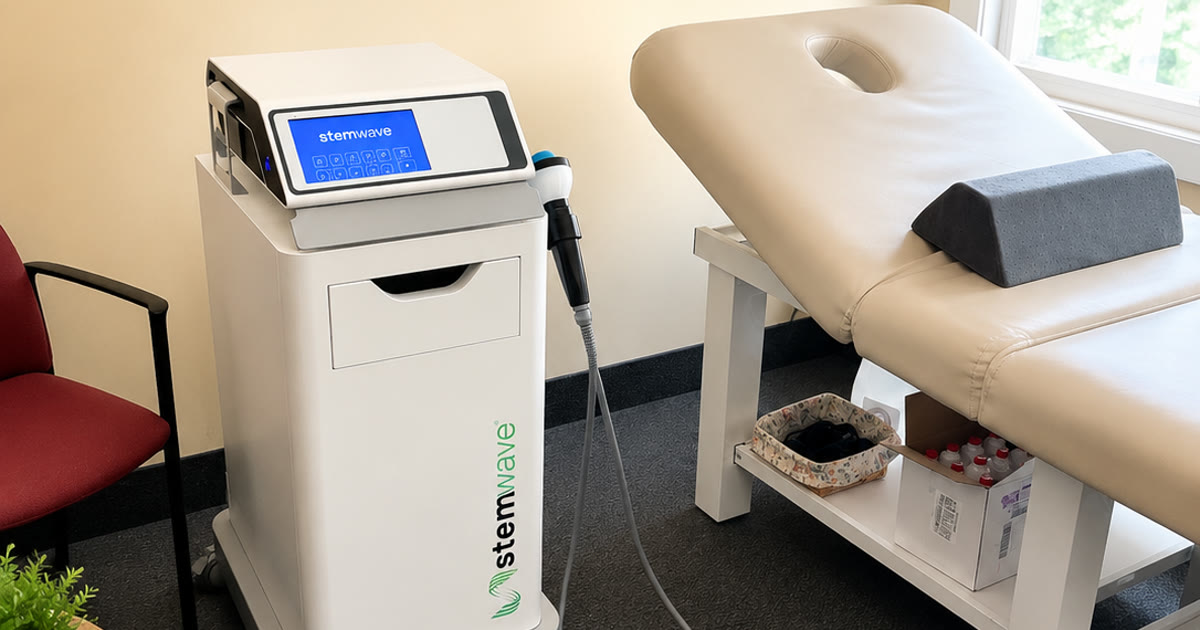
StemWave delivers acoustic waves into soft tissue through a handpiece. The waves are designed to stimulate your body's natural healing response in stubborn tendon and soft-tissue areas. That is the whole idea, and it is also the reason for caution: anything designed to stimulate tissue activity is something you want to avoid in places where stimulation could be unwelcome, such as near a growing tumor, over fragile skin, or in someone whose blood does not clot normally.
Contraindications are not a sign that the technology is dangerous for the average person. They are the screening step that keeps it appropriate. A good provider takes the history first and the handpiece out second.
Is Shockwave Therapy Safe During Pregnancy?
Pregnancy appears on essentially every contraindication list. There is not a body of research that establishes shockwave as safe for a developing baby, so the standard approach is simple: not during pregnancy. If you are pregnant or may be, tell us before any exam. There are other ways to address back, hip and pelvic discomfort during pregnancy, and we are glad to talk through what is appropriate.
Can You Have Shockwave Therapy With a Pacemaker or Implant?
A cardiac pacemaker is a listed contraindication, particularly when treatment would be anywhere near the chest. Other implants, such as nerve stimulators or insulin pumps, are worth mentioning too, because the right answer depends on the device and on where we would be working. Bring the device card, or tell us the manufacturer, and we will make a careful decision. Often the answer is a clear no for that area.
What If You Take Blood Thinners or Have a Clotting Disorder?
Acoustic waves can cause temporary redness and bruising in the treated area even in healthy people. When blood does not clot normally, whether from a clotting disorder or from medication such as warfarin or other anticoagulants (MedlinePlus explains how blood thinners work), bruising can become more significant, and a collection of blood under the skin (a hematoma) becomes more of a concern.
This is one reason a medication list matters at your first visit. Do not stop any prescribed medication to qualify for treatment. That is a decision for your prescribing doctor, and we would never ask you to make it for us.
What About Cancer or a Known Tumor Near the Area?
Because shockwave is designed to stimulate tissue, it is not used over or near a known malignancy. If you have a history of cancer, tell us the type, where it was, and where you are in follow-up. A history of cancer is not automatically a "no" for an unrelated body part, but it is a conversation we want to have with you, and often with your oncology team, before anything else happens.
Can You Be Treated Over Infected or Broken Skin?
If the skin over the treatment area is broken, rashy, swollen, or infected, we wait. The handpiece and gel need to sit on intact, healthy skin. This one is usually temporary. Once the skin has healed, the question can be revisited.
How Long After a Cortisone Shot Should You Wait?
This surprises people. If you have had a corticosteroid injection in the same spot recently, many protocols ask you to wait before using shockwave there. The NHS page above lists three months. The reasoning is that steroid injections can affect how tendon tissue behaves and how well it handles stimulation.
If you are comparing the two approaches, our article on StemWave vs cortisone injections walks through how they differ. If you recently had a shot, give us the date and location and we will tell you how long we would want to wait.
Is Shockwave Therapy Appropriate for Children and Teens?
Children and adolescents have growth plates, areas of developing cartilage near the ends of long bones. Treatment over or near growth plates is generally avoided until bone growth is complete. If you are a parent, this is the right instinct to hold on to: a young athlete with heel or knee pain should be evaluated first, and the evaluation will tell us whether anything with a handpiece belongs in the plan at all.
Which Body Areas Are Avoided?
The OSU overview lists injuries near the brain, major nerves and the lungs among reasons not to treat. Practically, this means treatment is directed at limbs, tendons and muscle attachments, and not at the chest, the head, or directly over major nerve pathways. Numbness or tingling can occasionally occur if a nerve is stimulated, which is why we stay attentive to what you tell us during a session and adjust.
What If a Tendon Is Fully Torn?
Shockwave is aimed at tendons and soft tissue that are irritated, stalled or healing slowly. A fully ruptured tendon is a different problem. It needs a medical or surgical evaluation first. If you felt a pop, cannot move a joint the way you could last week, or see a visible deformity, tell us right away and we will refer you for imaging and a physician's opinion before anything else.
What Else Do We Ask About Before Treatment?
Beyond the clear contraindications, some situations are "it depends":
- Severe circulation problems. Vascular disease can change how tissue responds, and treatment over poorly perfused tissue is something to approach carefully.
- Allergies. Latex or gel allergies matter, and we want to know.
- Pain medicines. The NHS page notes that anti-inflammatory medicines are not recommended around treatment, while paracetamol (acetaminophen) may be acceptable. Check with your doctor or pharmacist about your own medications rather than guessing.
- Neuropathy. If you have reduced sensation, such as from diabetes, you may not feel what the handpiece is doing the way someone else would, so we adjust our approach.
None of these is a blanket answer. They are reasons to take a careful history, which is exactly what the first visit is for.
What Does StemWave Screening Look Like in Bowie, MD?
At Total Wellness Chiropractic, nobody goes straight to the handpiece. A first visit includes:
- A conversation about where it hurts, how long, and what you have already tried.
- A medication list, implant list and medical history review.
- A hands-on exam of the area, so we know whether the problem looks like the kind of soft-tissue issue StemWave is designed for.
- A plain answer: yes, not yet, or no, and what we would suggest instead.
"Not yet" and "no" are real answers here. If you are not a candidate, we would much rather tell you than book you. And if the problem needs imaging or a physician, we will say so. You can see the range of problems we typically evaluate on our conditions page, and the rest of our offerings under services.
If you are weighing the technology more broadly, start with what StemWave therapy is and how many sessions people typically need.
Frequently Asked Questions
Who should not get shockwave therapy?
Commonly listed exclusions are pregnancy, pacemakers near the treatment area, bleeding or clotting disorders and blood thinners, known tumors in or near the area, infection or open wounds at the site, recent steroid injections in the same spot, and treatment over growth plates, the lungs, the brain or major nerves. Your provider should screen for all of these before starting.
Can I have shockwave therapy if I take blood thinners?
Blood-thinning medication is a commonly listed reason to avoid it, because of the increased bruising and bleeding concern. Never stop a prescribed medication on your own. Ask your prescribing doctor, and tell us what you take so we can decide together whether it is appropriate.
Is shockwave therapy safe during pregnancy?
It is not recommended during pregnancy. Please tell us at your first visit if you are pregnant or trying to become pregnant.
How long after a cortisone shot can I have shockwave therapy?
Some protocols, including the NHS guidance cited above, suggest waiting about three months for the same area. We would look at the date and location of your injection before recommending anything.
What are the common side effects?
Typical reports include temporary redness, mild swelling, bruising, and a dull ache for a day or so afterward. Occasionally people notice numbness or tingling. If something feels unusual, tell us during the session, because we can adjust the settings. Individual experiences vary.
Does having a contraindication mean I can never have it?
Not always. Some are temporary, such as a skin infection or the waiting period after a steroid injection. Others, such as a pacemaker near the area, are more permanent. The first-visit screening sorts one from the other.
How much does it cost to find out if I'm a candidate?
Your first StemWave session is $50. Your evaluation and screening come first, and we will tell you plainly if we do not think you are a candidate.
Not Sure If You Are a Candidate?
Reading a list like this one can make you either more worried than you should be or more confident than you should be. Neither is the goal. The goal is a real person looking at your history and your body and telling you honestly what makes sense.
If you live in Bowie, Crofton, Mitchellville, Glenn Dale, Lanham, Largo, Upper Marlboro or elsewhere in Prince George's County and you want to know whether StemWave is an option for you, we would be glad to see you.
Total Wellness Chiropractic 6000 Laurel Bowie Road, Suite 202, Bowie, MD 20715 (301) 352-3454 Book an appointment · See StemWave · All services
StemWave first session: $50.
This article is for educational purposes and is not medical advice. StemWave uses acoustic wave technology designed to stimulate the body's natural healing response; it is not a cure for any condition, and individual results may vary. Contraindication lists vary by source and device and this article is not a complete list. Talk with a qualified healthcare provider about your specific condition, medications and history before beginning any new treatment.
Sources: Homerton University Hospital NHS Foundation Trust, Shockwave Therapy · Ohio State University Wexner Medical Center, Shockwave Therapy · MedlinePlus, Blood Thinners (National Library of Medicine)