"Safe" is the question under every other question people ask me about body contouring. They come in asking how many sessions it takes or whether it works on the midsection, but what they actually want to know is whether they are about to do something to their body that they will regret.
That is a fair thing to want a straight answer to, and it deserves better than "totally safe, don't worry about it." So this is the long version: what the published trials actually recorded, what the real precautions are, who should talk to a physician first, and what results look like when the protocol is run properly.
Is Red Light Body Contouring Safe? What the Evidence Shows
Here is the short answer to "is red light body contouring safe": across the published clinical trials, red light body contouring has an unusually quiet safety record. Trial after trial reports no adverse events, no skin changes in the treated areas, and no recovery period. The light does not heat tissue enough to burn it, does not freeze it, does not break the skin, and does not require anesthesia. Nothing is destroyed; fat cells simply release what they are storing and shrink, and your body burns the released fat as fuel.
The longer answer is that "no adverse events reported" is not the same sentence as "nothing can go wrong for anybody." There are real contraindications, there is one genuine precaution, and there is a difference between a device being safe and a clinic using it responsibly. All three are below.
What "low-level" actually means
Most of the anxiety about this comes from the word laser. People picture surgical lasers that cut and cauterize, and reasonably wonder what that is doing over their abdomen.
Red light body contouring uses a completely different category of device. In the six-week trial published in the Journal of Clinical and Aesthetic Dermatology, the device used six 635nm diodes at 17 milliwatts each. For scale, that is a fraction of the output of a household light bulb, spread across a broad area. The published energy density worked out to roughly 0.0002 joules per cm² per minute at a three-inch distance.
That is the entire reason the safety profile looks the way it does. There is no meaningful thermal load. Nothing is being destroyed. This is a photochemical process, not a thermal one — which is also why sessions are described as feeling like nothing at all. The light prompts fat cells to open temporary pores and release stored triglycerides, fatty acids and glycerol; the cells shrink and your lymphatic system carries the released fat into circulation to be burned. Because no tissue dies, there is no inflammation, no bruising, and none of the paradoxical fat growth reported with cryolipolysis. If you want the mechanism in detail, I wrote it up separately in how red light body contouring works.
What the Trials Actually Recorded
Here are the numbers.
| Study | Design | Participants | Safety finding |
|---|---|---|---|
| Six-week protocol, JCAD 2016 (NCT02109107) | Open-label, 6 weekly sessions | 54 | "No reports of adverse events and no evidence of skin changes in the treated areas" |
| Upper-arm trial, JCAD 2012 | Double-blind, randomized, sham-controlled | 40 (20 active / 20 sham) | "The treatments were painless and no adverse events were reported" |
| Systematic review, Lasers in Medical Science 2025 | 3 randomized controlled trials | 160 | Concluded the treatment achieves localized circumference reduction "with minimal adverse effects" |
Two things are worth saying about that table.
First, these were properly run trials. The JCAD six-week study was approved by an institutional review board, registered on ClinicalTrials.gov, and 635 nm low-level laser went on to receive FDA marketing clearance for non-invasive circumference reduction. The safety record is not a marketing claim; it is the recorded outcome of registered clinical research.
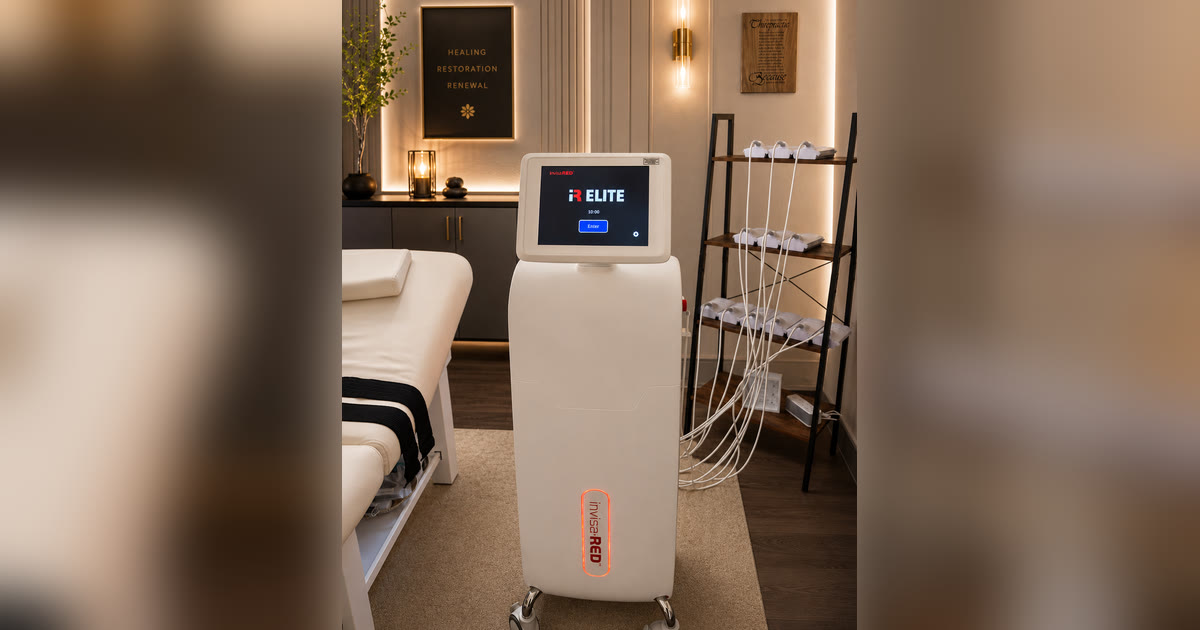
Second, InvisaRED is the same class of light at the same order of magnitude of power. The published trials largely used overhead scanner units. InvisaRED uses contact pads at similar wavelengths, which keeps the full dose on the tissue being targeted. The underlying physics, and the reason for the safety profile, is identical: low-power red light absorbed by fat cells, with no thermal load.
The Cancer Question
This is the one people are most reluctant to ask, so I will ask it for them: does putting red light on your body repeatedly do anything to cancer risk?
The most useful paper here is a 2023 systematic review in the Aesthetic Surgery Journal that looked specifically at the oncologic safety of low-level light therapy. It pulled together clinical trial safety data alongside laboratory data on human skin cells and neoplastic cells. Its conclusion was that within established parameters, current clinical and preclinical evidence suggests photobiomodulation is oncologically safe for aesthetic use, and that there is no evidence supporting the idea that people previously treated for cancer need to avoid it. The authors found no clinical trial data linking it to a new or recurrent malignancy.
That is reassuring, and it is also a review of skin rejuvenation rather than body contouring. So here is how I handle it in practice, which is more conservative than the paper requires: if you have active cancer, or you are currently under treatment for cancer, we do not do body contouring. That is a standard exclusion in the trials themselves, and it is a line I keep. If you have a history of cancer and are in remission, that is a conversation with your oncologist first, not a decision I make in my office.
Your Eyes Are the One Real Precaution
If there is a genuine hazard in this room, it is not your abdomen. It is your eyes.
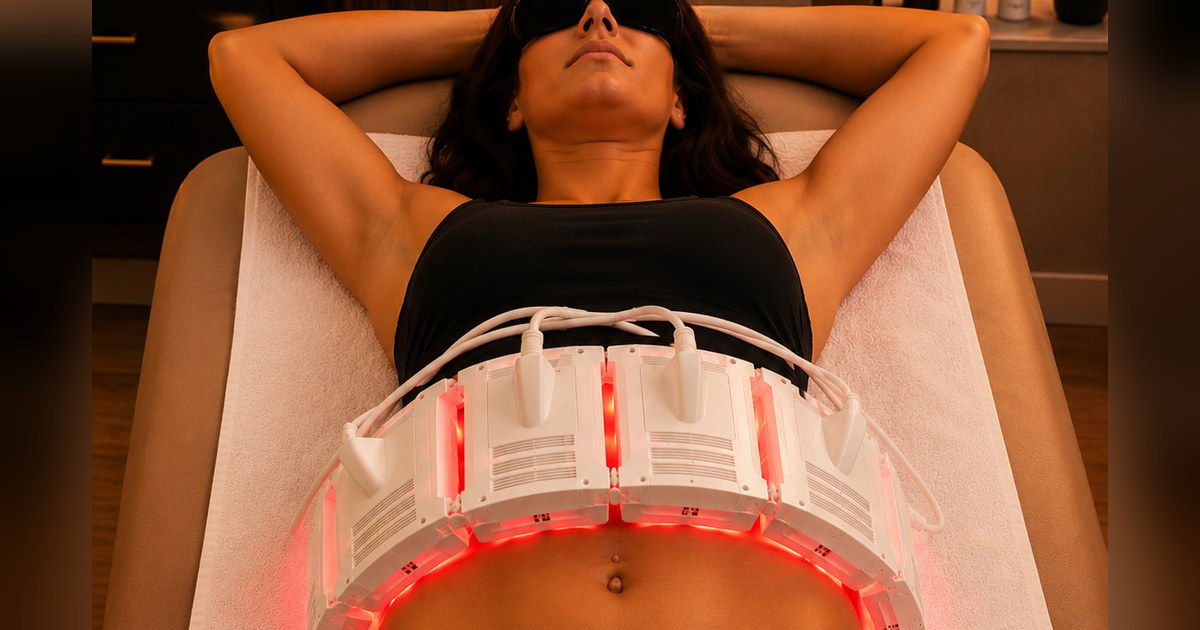
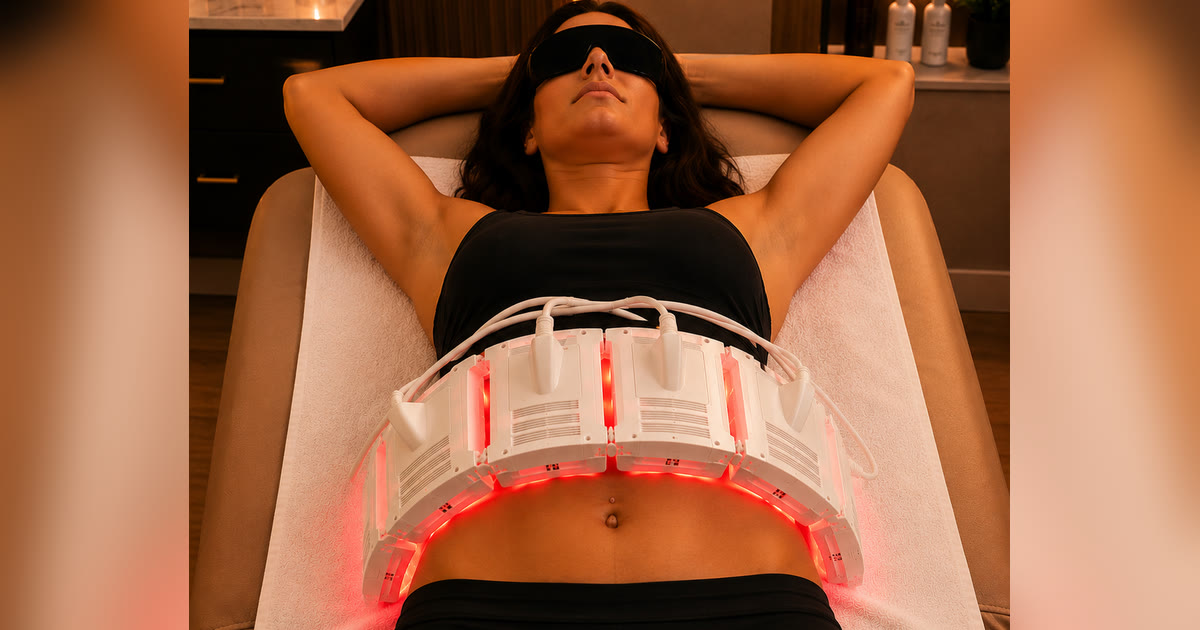
Direct, sustained exposure of the retina to laser light is the one adverse outcome with a real mechanism behind it, which is why the JCAD trial protocol required both the investigators and the subjects to wear safety glasses rated for 635nm red light throughout every session. Not as a formality — as the actual safety control.
So: if a clinic hands you eye protection, that is a sign they are running the protocol properly. If a clinic does not, ask why. That is the single easiest quality check a patient can perform, and it costs nothing.
Who Should Not Have Red Light Body Contouring
This is where "safe" stops being a property of the device and becomes a property of the screening. The published trials exclude people for specific reasons, and those exclusion lists — plus one common-sense addition about medications — make a ready-made screening protocol. The ones that matter most:
- Current pregnancy, or planning a pregnancy. This is a firm no, not a maybe. It is a standard trial exclusion and a standard device contraindication.
- Active cancer, or current cancer treatment. Covered above.
- Known photosensitivity disorders, including conditions like lupus that involve light reactivity.
- Photosensitizing medications. This is the one people forget. Tetracycline antibiotics, oral retinoids, some diuretics, some antifungals, certain NSAIDs and chemotherapy agents all raise light sensitivity. Bring your actual medication list to your consultation. Not a memory of it.
- Pacemakers, implanted cardiac devices, or prior cardiac surgery. Excluded in the trial protocols.
- Open wounds, active infection, or broken skin in the target area. Wait until it has healed.
- Prior surgical body sculpting — liposuction, abdominoplasty, lap band — was a trial exclusion, meaning we have less evidence about what happens in that population, not that something bad is known to happen.
If one of these applies to you, it is not automatically the end of the conversation — it just needs to come up in the first ten minutes of a consultation so we can plan around it. I go through this list before anyone gets on the table, and I walk through what that intake looks like in what to expect at your first InvisaRED session.
What Results Look Like
Safe is the floor. Here is what the same trials recorded on the results side.
The six-week JCAD trial reported a mean combined circumference decrease of 5.4 inches across the waist, hips, both thighs and upper abdomen after six weekly sessions, and 6.2 inches two weeks after the last session, because the body keeps burning what was released. Roughly 72 percent of participants hit the study's 4.5-inch combined threshold, 81 percent rated themselves satisfied or very satisfied, and there were zero adverse events. A Mayo Clinic randomized pilot recorded about 2 inches off the waist at six weeks along with reductions in body weight, BMI and fat mass. Individual results may vary.
The fat your cells release does not disappear on its own. Your body has to metabolize it, and that is where the energy math gets interesting. InvisaRED reports that a single session can trigger a metabolic response equivalent to burning up to roughly 2,000 calories, and that your metabolism stays elevated for up to 72 hours afterward. That is why we tell patients to take a walk after a session and stay hydrated: you are giving your body the signal to use what was just released as fuel. Done one to three times a week over a series, that is a meaningful push toward both inch loss and weight loss. I explain why the inches show up before the pounds in how InvisaRED helps you lose inches and pounds.
For patients who want both a smaller waist and a lower number on the scale, InvisaRED pairs with our doctor-supervised weight loss program: the medical side supports appetite and whole-body metabolism, and the light targets the specific areas you want to shrink. If you are weighing it against the freeze-and-destroy option, InvisaRED vs CoolSculpting compares the two.
Comfortable, no downtime, measurable results. That combination is why we chose this technology.
Body Contouring Safety at Our Bowie, MD Office
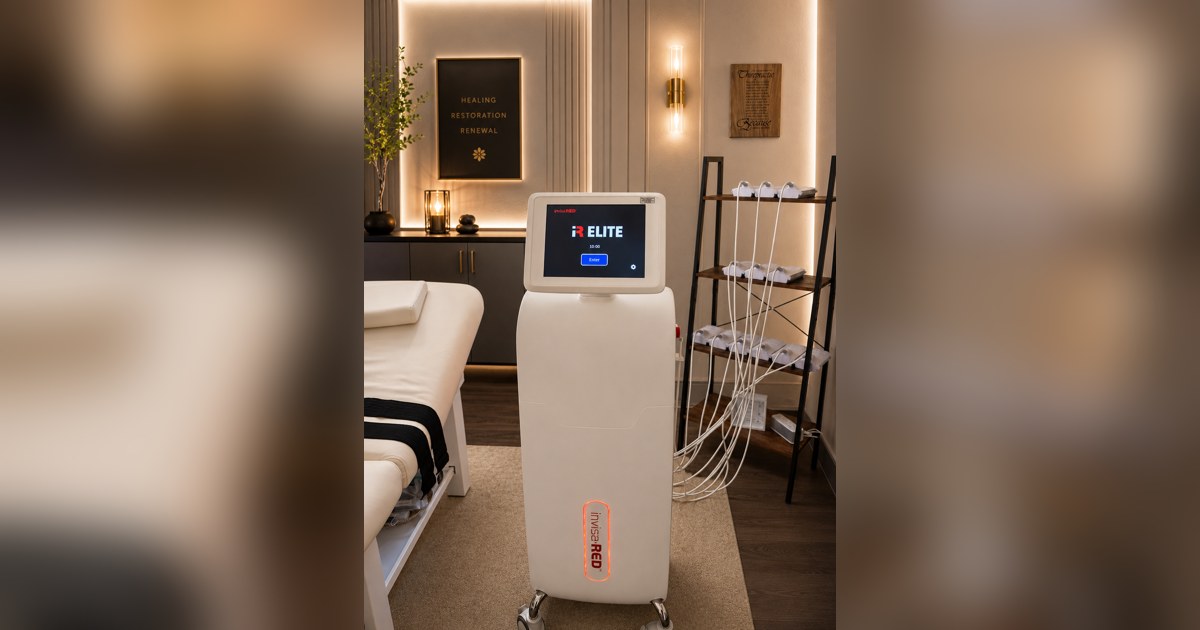
Practically, here is what the screening and safety protocol looks like at Total Wellness Chiropractic in Bowie — and what you should expect anywhere in Prince George's County:
- A real intake before a real session. Medications, pregnancy status, cancer history, implanted devices, photosensitivity, skin integrity in the target area. Every time, not just the first time.
- Baseline measurements with recorded reference points. In the published trial, the same trained person took every measurement and recorded the distance from a fixed landmark like the hip bone, so follow-up measurements land in the same place. We do the same, so when your number drops you know it is real.
- Eye protection, every session, for you and for whoever is running the unit.
- A stated protocol and a stated review point — you should know before you start how many sessions we are planning and when we are going to look at the numbers together.
- Post-session guidance. A walk and good hydration after every session, because that is how your body burns what the light released.
We see patients from Bowie, Crofton, Mitchellville, Glenn Dale, Upper Marlboro, Lanham and Largo, and the screening is the same regardless of how far you drove. You can see the full list of what we offer on our services page and our body contouring and weight loss page.
Frequently Asked Questions
Does red light body contouring hurt?
No. There is no heat, no cold, no suction and no needle. The authors of the sham-controlled upper-arm trial described the treatments, in their words, as painless. I wrote a fuller answer to this one in what to expect at your first InvisaRED session.
Are there side effects after a session?
The trials cited above reported no adverse events, and the 2025 review of the randomized trials described adverse effects as minimal. There is no recovery period and no activity restriction — people go back to work, to the gym, to their Saturday.
Is it safe to do repeatedly, week after week?
Yes. The six-week protocol trial ran one session per week for six consecutive weeks and recorded no adverse events and no skin changes across the whole course, and the Roche trial ran three sessions a week for four weeks with the same clean record. Many of our patients continue with maintenance sessions once or twice a month.
Can I do this if I am pregnant?
No. Pregnancy and planned pregnancy are standard exclusions in the clinical trials and standard contraindications for these devices. Come back afterward.
Will red light body contouring damage my eyes?
Not if the protocol is followed. Eye protection rated for the device's wavelength is required for both the patient and the operator, and that requirement is the reason the risk stays theoretical. If nobody offers you glasses, ask.
Does it interfere with medications?
Some medications increase photosensitivity, which is why the medication list is part of the intake rather than an afterthought. Bring the list, including supplements — do not rely on memory.
Is it safe alongside chiropractic care?
Yes, and for a lot of our patients that is exactly how it fits — body contouring support on the same visit as the care they are already here for. If that is your situation, it is worth reading why back pain keeps coming back for how we think about programs rather than one-off visits.
Ready to See the Inches Come Off?
If you have read this far, you are the kind of patient I like working with — someone who wants to understand the safety record before booking. Here it is: no adverse events across the published trials, no downtime, no needles, no cold, no suction, and a screening protocol we run on every patient before the first session.
Your first InvisaRED session is $59, and it includes your consultation, baseline measurements and a full treatment, so you can feel the difference before you commit to a series. Most people are in and out in about an hour, and back to their day with nothing to recover from.
Book online at wherethehealingbegins.com or call (301) 352-3454.
Total Wellness Chiropractic · 6000 Laurel Bowie Road, Suite 202, Bowie, MD 20715 · (301) 352-3454 — serving Bowie and Prince George's County.
This article is for educational purposes only and is not medical advice. InvisaRED is an FDA-cleared, non-invasive red light body contouring system used at Total Wellness Chiropractic as part of our weight loss and body contouring program. It is not intended to diagnose, treat, cure, or prevent any disease. The clinical trials cited studied 635 nm low-level laser devices; calorie and metabolism figures are reported by the manufacturer. Individual results may vary. Talk with your physician before beginning any new program, particularly if you are pregnant, have a history of cancer, take photosensitizing medications, or have an implanted medical device.