Nobody reads an article about car accidents before they need it.
So if you're reading this in a parking lot on Collington Road, or in your kitchen the morning after something happened on US-50, here's the short version first, and then the detail.
The short version: make sure everyone is safe, get police involved, document everything before you leave the scene, notify your own insurer, and get evaluated — even if you feel fine right now. Especially if you feel fine right now.
That last part is where most people in Bowie go wrong, and it's the part that's hardest to undo later.
This guide walks through what to do after a car accident in Bowie, MD in the order things actually happen: the first hour, the first few days, the first two weeks, and the weeks after that. It covers how Maryland's insurance rules work, what deadlines are real, and where chiropractic care fits into recovery and documentation.
First: this is a common event in Prince George's County
Crashes here are not rare, and they are not evenly spread out. Prince George's County has recorded more traffic fatalities than any other county in Maryland on state and local roads combined, according to state crash data compiled through Zero Deaths Maryland — despite not being the state's largest or densest county.
Around Bowie, the collision corridors are predictable to anyone who drives them daily:
- US-50 — high speed, heavy volume, sudden slowdowns near the MD-197 and MD-3 interchanges
- MD-197 / Collington Road — the retail-and-light-cycle corridor where rear-end collisions cluster
- US-301 — high-speed traffic through Upper Marlboro and Bowie
- MD-450 / Annapolis Road — commuter congestion through Glenn Dale and Lanham
- Route 214 and MD-3 — merging and lane-change collisions
The type of crash matters clinically. A low-speed rear-end impact on Collington Road at a red light produces a different injury pattern than a highway collision — but it is a mistake to assume the low-speed one is harmless. More on that below.
The first hour: at the scene
1. Check for injuries and call 911
If anyone has lost consciousness, has a severe headache, is confused, has trouble speaking or seeing, has weakness or numbness anywhere, chest pain, or significant bleeding — that is an emergency room situation, not a "see how it feels tomorrow" situation. Call 911 and go.
Maryland law also requires drivers to render reasonable assistance and to arrange transport for anyone who requests or clearly needs medical treatment.
2. Get the police there
A police report is the single most useful document produced on the day of a crash. It records position, time, statements, and citations while everyone's memory is fresh. If the other driver suggests handling it privately without police, decline politely.
Maryland's accident reporting statute also requires that when a crash results in bodily injury or death and no officer is present at the scene, the driver report it to the nearest police authority — and drivers involved in an injury crash must file a written report with the Motor Vehicle Administration within 15 days (Md. Transportation § 20-107).
3. Document before anything moves
Assume you will need to prove this later to someone who wasn't there. On your phone:
- All four corners of both vehicles, plus wide shots showing lane position
- License plates, VINs, the other driver's license and insurance card
- The intersection or mile marker, signage, skid marks, debris, weather, lighting
- Any visible injury
- Names and phone numbers of witnesses — they leave fast, and they're hard to find later
4. Say very little about your condition
You do not know yet whether you're injured. "I'm fine" is a sentence that gets quoted back to people for months. Neither lie nor speculate — "I'm shaken up, I'm going to get checked out" is honest and accurate.
5. Don't discuss fault
Not with the other driver, not with their insurance adjuster. Maryland uses a strict contributory negligence standard, which makes casual apologies at the scene far more consequential here than in most states. Fault is a legal question. Answer questions from your own insurer factually, and route anything else to an attorney.
The first 24 to 72 hours: the part people get wrong
Here is the single most important clinical point in this article.
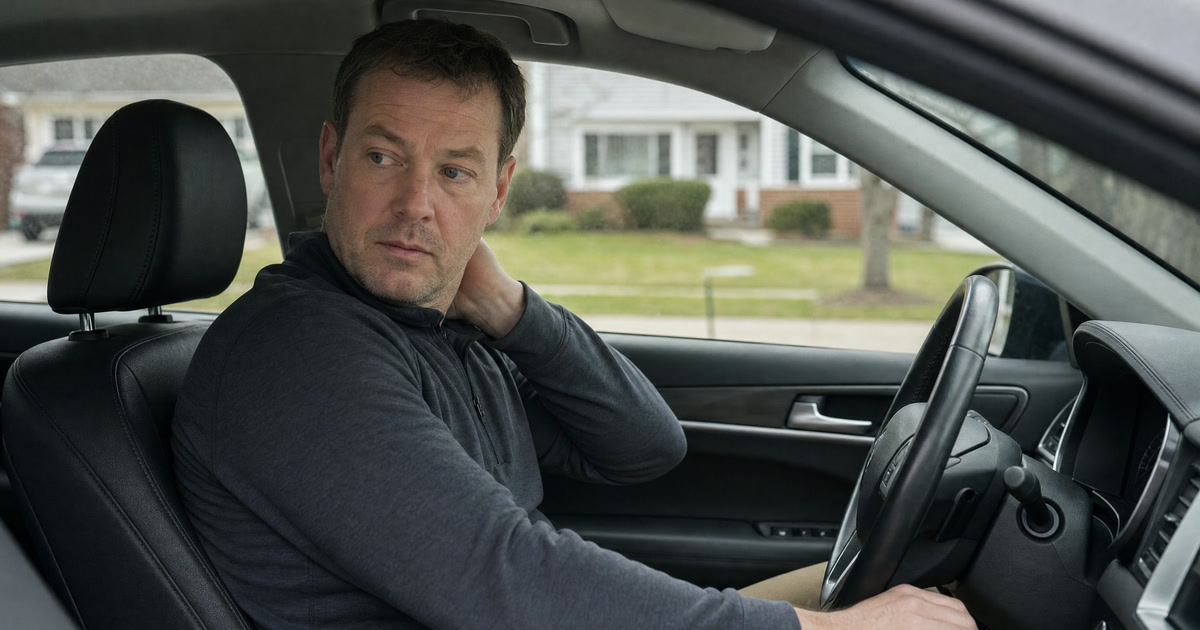
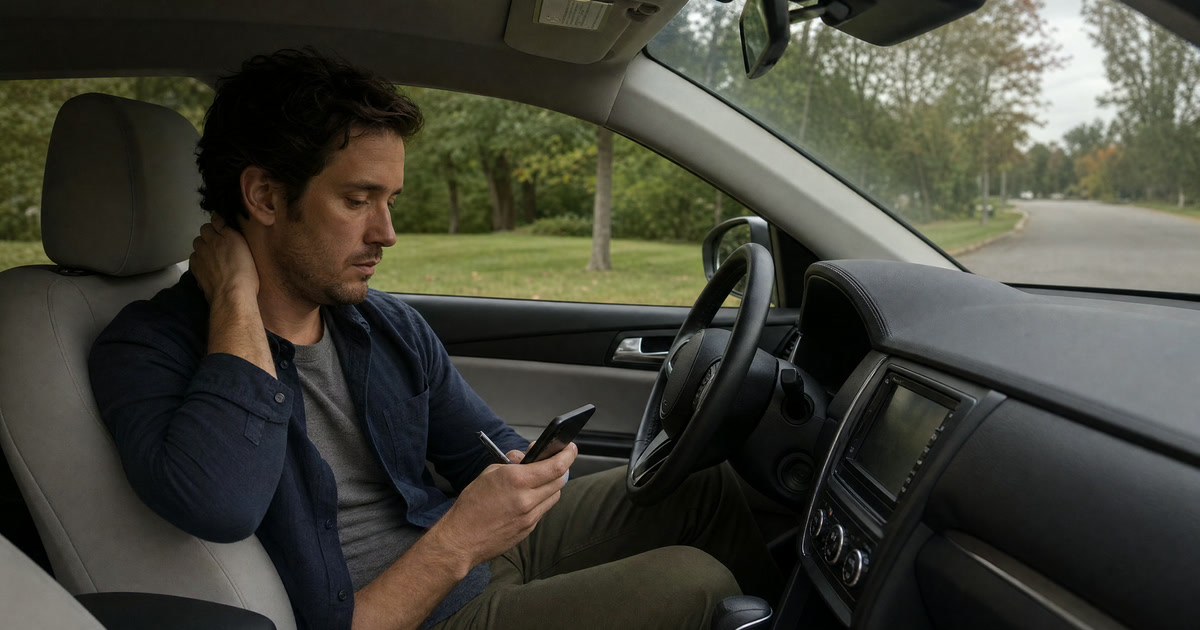
Feeling okay at the scene does not mean you weren't injured. Adrenaline and the sympathetic stress response blunt pain for hours. Muscle guarding, inflammation, and soft-tissue swelling develop over the following one to three days. It is extremely common for someone to walk away from a collision feeling stiff at worst, and wake up 48 hours later unable to turn their head to back out of the driveway.
This is well described in the whiplash literature — the delayed presentation reflects a developing injury process rather than an instantly appearing one, which is why an initially "mild" crash can produce meaningful symptoms days later (Whiplash-Associated Disorders review, PubMed).
Symptoms that commonly appear late
| Symptom | Typical onset | What's usually involved |
|---|---|---|
| Neck stiffness, reduced rotation | 12–72 hours | Cervical soft tissue, joint restriction |
| Headache at the base of the skull | 1–4 days | Cervicogenic referral from upper cervical segments |
| Upper back and shoulder blade pain | 1–5 days | Thoracic and scapular muscular strain |
| Low back pain and stiffness | 1–7 days | Lumbar joint and soft-tissue strain |
| Numbness or tingling in an arm or hand | 2–14 days | Nerve irritation, thoracic outlet, swelling |
| Dizziness, brain fog, poor sleep | 1–7 days | Concussive or vestibular involvement — needs evaluation |
| Jaw pain or clicking | 3–14 days | TMJ loading during impact |
Red flags that mean go now, not later
Call your physician or go to an emergency department promptly for: loss of consciousness at any point, a severe or rapidly worsening headache, repeated vomiting, vision changes, slurred speech, progressive weakness or numbness, chest or abdominal pain, difficulty breathing, or any change in bowel or bladder control. Chiropractic care is not a substitute for emergency evaluation, and no responsible chiropractor will tell you otherwise.
Low-speed crashes still produce real injuries
Patients tell me all the time: "There's barely a scratch on the bumper."
Vehicle damage and occupant injury are not the same measurement. Modern bumpers are engineered to absorb and rebound. Energy that isn't spent deforming metal still has to go somewhere, and a rigid bumper can transfer more of it into the occupant rather than less. The body's tolerance is also highly dependent on things a photo of the bumper can't show: head position at impact, whether you saw it coming, headrest height, seated posture, prior neck problems, and body size.
So the damage estimate is a poor proxy for whether you're hurt. How you feel over the next week is a much better one.
How Maryland insurance handles your medical care
This is where people lose money and access to care, purely from not knowing the rules.
PIP (Personal Injury Protection)
PIP reimburses medical expenses and some lost income for injuries from a crash regardless of fault. The Maryland Insurance Administration's consumer guide states that Maryland law requires minimum PIP coverage of $2,500, and that your insurer may offer higher PIP limits at additional cost (MIA Consumer Guide to Auto Insurance). Chiropractic care is among the medical expenses PIP is used for.
Two things worth knowing:
- PIP claims have a much shorter clock than injury lawsuits. Maryland law permits a policy to set a filing period of not less than 12 months after the date of the accident for the original PIP claim (Md. Insurance § 19-508). Do not wait until treatment is finished to open the claim — open it early and supplement it. That same section requires that once your insurer receives written notice of the accident, it must notify you by mail of the latest date you can file. Your policy's specific deadline is a question for your insurer.
- A not-at-fault claim has some protection. Maryland law provides that an insurer may not cancel or refuse to renew private passenger auto coverage based on claims history where two or fewer claims in the preceding three years were for accidents or losses the insured was not at fault for (Md. Insurance § 27-501(k)). That provision addresses cancellation and non-renewal — how any claim affects your specific premium is a question for your own insurer, not something I can answer for you. A lot of people never use coverage they already paid for because they assume the worst without asking.
You may also have waived or reduced PIP when you bought the policy. Check the declarations page rather than assuming.
The three-year deadline is not your real deadline
Maryland gives three years from the date the claim accrues to file a civil action (Md. Courts & Judicial Proceedings § 5-101). People hear "three years" and relax.
That's the deadline to file suit. It has nothing to do with when care should start, and waiting hurts you twice: clinically, because early appropriate care matters, and practically, because a long unexplained gap between the crash and the first medical visit is the first thing an adjuster points to.
Why an early evaluation matters clinically — not just for the claim
I want to be careful here, because there's a version of this advice that oversells.
The evidence on whiplash-associated disorders supports education, reassurance, active movement, and mobilization, and suggests active care works better when it starts earlier rather than after weeks of waiting (early intervention trial, PubMed). What the evidence does not support is aggressive, high-volume passive treatment right out of the gate. Large cohort data actually associates excessive early health care utilization with slower recovery (Côté et al., PubMed).
So the honest framing is this: get evaluated early, start moving appropriately early, and be skeptical of any plan that front-loads dozens of passive visits before anyone has established what's actually wrong.
Car Accident Chiropractor in Bowie, MD
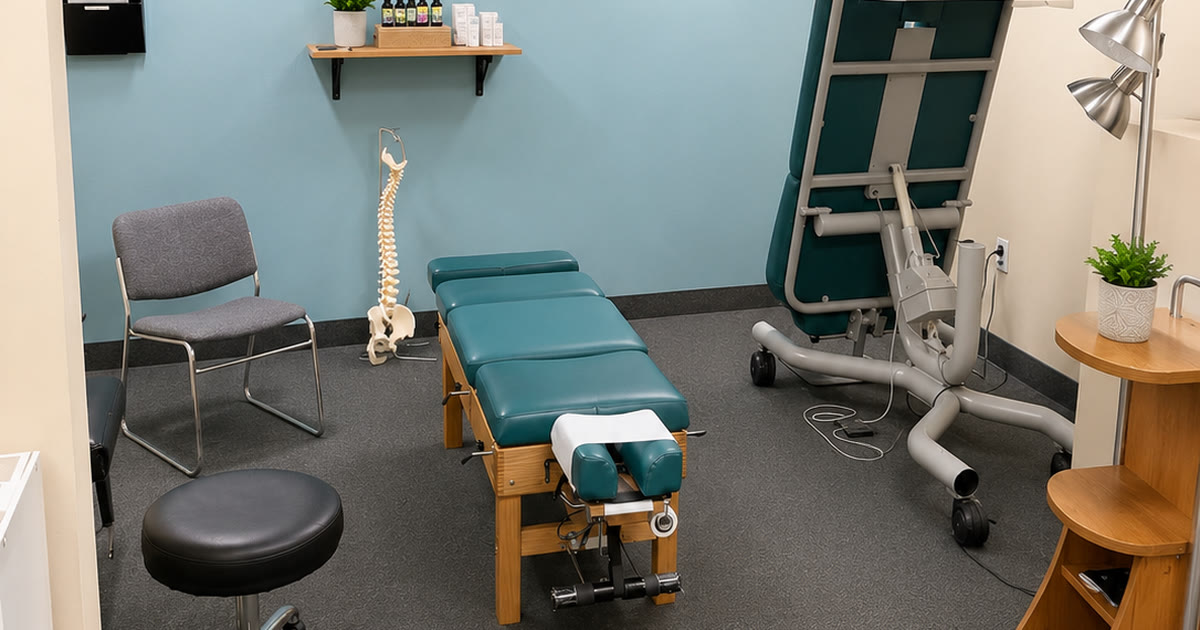
A first visit after a collision should be an assessment, not a sales pitch. At our Bowie office that means history and mechanism of injury, a neurological and orthopedic screen, range of motion and joint assessment, red-flag screening, imaging referral if indicated, and a written plan with a defined reassessment point. Care may include chiropractic adjustment, soft-tissue work, and graded rehabilitative exercise — approaches designed to restore normal joint motion and support the body's own recovery process, not to "fix" an injury in one visit.
If your presentation needs an orthopedist, neurologist, or imaging, you should be told that plainly and referred.
We see patients from across Prince George's County — Bowie, Crofton, Mitchellville, Glenn Dale, Upper Marlboro, Lanham and Largo — and a lot of them arrive after something on US-50 or Collington Road. If you are searching for a car accident chiropractor near you and you are anywhere in that stretch, we are on Laurel Bowie Road, a few minutes off MD-197.
Documentation: what your records need to show
If there's a claim, your medical record becomes evidence. That doesn't change how care should be delivered, but it does mean thorough records matter. Useful documentation includes:
- Date of onset tied to the crash — the record should connect mechanism to findings
- Objective measurements, not just "patient reports neck pain" — range of motion in degrees, orthopedic test results, neurological findings
- Functional impact — what you can't do at work, at home, sleeping, driving
- Consistent attendance — gaps in treatment are read as evidence you recovered
- Discharge or re-evaluation notes showing progress or plateau
To be direct about scope: a chiropractor documents your injuries, your findings, and your response to care. We do not value claims, predict settlements, or give legal advice. Those belong to your insurer and your attorney.
Your realistic first-two-weeks checklist
| When | Do this |
|---|---|
| At the scene | Safety, 911, police report, photos, witness contacts, say little |
| Same day | Emergency evaluation if any red flags; notify your own insurer |
| Within 24–72 hrs | Get evaluated even without symptoms; start a symptom journal |
| Within 15 days | File the written MVA report if the crash caused injury |
| Within 30 days | Open the PIP claim; don't wait for treatment to end |
| Ongoing | Attend appointments consistently; report new symptoms as they appear |
Keep a simple daily note: pain location, 0–10 rating, what you couldn't do, sleep quality. Three lines a day. It's more accurate than trying to reconstruct six weeks of symptoms from memory later.
Frequently asked questions
Should I see a chiropractor or go to the ER after a car accident?
Both have a role. Red-flag symptoms — loss of consciousness, severe headache, vision changes, weakness, chest pain, bowel or bladder changes — go to the emergency department first, always. Chiropractic evaluation is appropriate for the musculoskeletal complaints that typically follow: neck, mid-back, and low back pain, stiffness, and headaches. Many patients do both: ER to rule out serious injury, then chiropractic for the ongoing soft-tissue and joint problems the ER doesn't manage.
How long after a car accident should I wait to be seen?
Sooner is generally better — ideally within the first few days. Waiting doesn't make a soft-tissue injury go away; it just means you begin care with more guarding and compensation already established, and it creates a gap in the record.
Do I need a referral to see a chiropractor in Maryland after an accident?
Maryland law defines the practice of chiropractic to include diagnosing and treating within a chiropractor's scope (Md. Health Occupations § 3-101), and our office can evaluate you directly. What varies is your coverage: some health plans require a referral or pre-authorization for chiropractic even when the law does not. Call the number on your insurance card and ask before your first visit, or call us and we'll help you sort out what your plan needs.
Will using my PIP coverage affect my policy?
Maryland law limits an insurer's ability to cancel or refuse to renew based on not-at-fault claims history (Md. Insurance § 27-501(k)), and PIP itself pays regardless of fault. How a claim affects your particular premium depends on your carrier and your policy, so ask your insurer directly rather than assuming — that assumption is the reason a lot of people leave coverage they already paid for unused.
What if the accident wasn't my fault — do I still use my own PIP?
Yes. PIP is no-fault coverage that pays regardless of who caused the crash, which is precisely why it exists: it gets care started without waiting for liability to be sorted out.
I feel completely fine. Do I really need to be checked?
It's the most common thing I hear, and the most common thing people regret. Getting evaluated when you feel fine costs you one visit. Skipping it and developing symptoms three weeks later costs you both a harder recovery and a much weaker record.
How many visits will I need after a car accident?
It depends entirely on findings and response — anyone who quotes a visit count before examining you is guessing. A reasonable plan has an active phase with a defined reassessment point, then tapers based on progress.
The bottom line
The instinct after a crash is to minimize it. You're rattled, you have somewhere to be, the car mostly works, and nothing hurts badly yet. So you tell yourself you're fine and get on with your day.
Three days later, you can't turn your head.
Get police involved. Photograph everything. Notify your insurer. Open the PIP claim early. And get evaluated in the first few days, whether or not you're in pain — because the point of an early evaluation is to find out, not to confirm what you already assume.
We're at 6000 Laurel Bowie Road, Suite 202, Bowie, MD 20715, serving Bowie, Crofton, Mitchellville, Glenn Dale, Upper Marlboro, Lanham, and Largo. Call (301) 352-3454 or book an appointment online. You can review the conditions we work with, our full list of services, and our StemWave therapy options for pain that lingers past the acute phase.
This article is for educational purposes and is not medical or legal advice. Individual results may vary. Insurance and legal questions should be directed to your insurer or a licensed attorney. If you have severe, worsening, or neurological symptoms after a collision, seek emergency evaluation immediately. Talk with a qualified healthcare provider about your specific condition before beginning any new treatment.