You got rear-ended on MD-197 on Friday. You felt rattled, a little shaky, but basically fine. You traded insurance information, drove home, and went about your weekend.
Now it's Monday and you can't check your blind spot without turning your whole torso.
This is one of the most common stories we hear at our Bowie office, and if it's your story right now, the first thing worth saying is that nothing has gone wrong with you. Delayed whiplash symptoms after a car accident are the rule, not the exception — the injury happened at the moment of impact, but the signal that tells you about it can take hours or days to arrive.
Here's what actually shows up late, roughly when, and how to tell the difference between "this is the normal arc of a soft-tissue injury" and "this needs attention right now."
Why Delayed Whiplash Symptoms After a Car Accident Are So Common
Whiplash isn't a diagnosis so much as a mechanism. The International Headache Society defines it as "sudden and inadequately restrained acceleration/deceleration movements of the head with flexion/extension of the neck" — and adds, importantly, that whiplash "may occur after either high or low impact forces" (ICHD-3, section 5.3).
That head-and-neck whip happens in a fraction of a second. Muscles that were relaxed get loaded before they can brace. Ligaments that hold the cervical vertebrae in alignment get stretched past their normal range. Small joints at the back of the neck — the facet joints — get compressed and torqued. None of that is visible from outside the car, and most of it doesn't hurt immediately.
Three things explain the delay:
Adrenaline. In the minutes after a collision your body is running on stress hormones that are extremely effective at suppressing pain. This is not a metaphor — it's why people walk away from serious crashes and tell the officer they're fine, and mean it.
Inflammation takes time to build. A strained muscle or sprained ligament doesn't swell instantly. The inflammatory response ramps up over the following 6 to 48 hours, and it's the swelling and chemical irritation — not the tearing itself — that most of the pain comes from.
Protective guarding sets in slowly. As the surrounding muscles tighten to splint an irritated joint, motion gets restricted. That stiffness often announces itself on the second or third morning, when you try to get out of bed and discover what your neck will no longer do.
The Typical Timeline: When Each Symptom Tends to Appear
Every case is different, and this is a general pattern rather than a schedule. But it's a useful frame.
Hours 0–6: Often Nothing
Many people feel essentially normal. Some notice a vague tightness across the shoulders, or a mild headache they attribute to stress. In one UK emergency department study of whiplash patients, the average time between the crash and arriving at the department was 541 minutes — about nine hours (Crouch et al., Emergency Medicine Journal, 2006). People wait, because at first there's nothing obvious to act on.
Hours 6–24: The Neck Announces Itself
This is when most neck pain and stiffness begins. It usually feels like a deep ache at the base of the skull and across the tops of the shoulders, worse with movement, worse after sitting still. Headache commonly starts in this window too.
Days 2–4: The Peak for Most People
Stiffness typically peaks here. Rotation and side-bending are the motions people lose first — checking a blind spot, looking up, sleeping on one side. Upper back pain between the shoulder blades often shows up now, as does jaw tightness.
Days 4–7: The Late Arrivals
Symptoms that seem unrelated to the neck tend to surface at the back end of the first week: dizziness, ringing in the ears, blurred vision, difficulty concentrating, disturbed sleep, numbness or tingling into an arm or hand. These are the ones people most often fail to connect to the crash, because a week has passed and the accident no longer feels like current events.
For headache specifically, the diagnostic criteria are precise: headache attributed to whiplash is defined as one that develops within seven days of the injury (ICHD-3, section 5.3). Seven days is a long window — long enough that most people have stopped thinking about the crash by the time the headache arrives.
Weeks 2–6: What Doesn't Resolve on Its Own
This is where the picture gets serious, and where the research is worth reading carefully. In the UK study above, two thirds of patients still had some measurable disability four to six weeks after the injury, assessed with the Neck Disability Index. About 21% fell into the moderate-disability range and 4% into the severe range. The authors also cite UK figures indicating roughly half of whiplash patients have not recovered by three months.
That's not a reason to panic. It is a reason to take the first week seriously rather than waiting to see whether it sorts itself out.
The Delayed Symptoms People Miss Most Often
Neck pain is obvious. These are the ones that get dismissed.
Jaw Pain and Clicking
The jaw is rarely the first thing anyone connects to a rear-end collision, but the evidence here is striking. A controlled prospective study enrolled 60 whiplash patients from a hospital emergency department (59 were followed up a full year later) alongside 53 frequency-matched control subjects. New temporomandibular joint (TMJ) pain, dysfunction, or both developed in 34% of the whiplash group versus 7% of controls — roughly five times the rate — and the authors concluded that about one in three people exposed to whiplash trauma is at risk of delayed TMJ symptoms (Salé and Isberg, Journal of the American Dental Association, 2007).
If you've started clenching at night, hearing a click when you chew, or getting jaw fatigue after a meal, and there was a crash a few weeks ago, those two facts may be connected.
Headaches That Feel Like Tension Headaches
Cervicogenic headache — pain referred to the head from irritated structures in the upper neck — typically presents as a band-like ache starting at the base of the skull and wrapping forward behind one eye. It is very easy to write off as stress, screen time, or dehydration.
Dizziness and Visual Disturbance
The upper cervical spine is dense with position-sensing receptors that feed your balance system. When those joints and muscles are irritated, the input gets noisy, and the result can be lightheadedness when you turn your head quickly, or trouble tracking moving objects.
Numbness, Tingling, or Weakness in an Arm
Irritation of a cervical nerve root can send symptoms down the arm into specific fingers. Tingling that follows a consistent path, especially with any weakness in grip, should always be evaluated rather than waited out.
Sleep Disruption, Irritability, and Trouble Concentrating
These get attributed to the stress of dealing with insurance and body shops, and sometimes that's exactly what they are. But they're also documented components of whiplash-associated disorder, and worth mentioning to whoever examines you.
"But the Car Was Barely Damaged"
This is the single most common reason people in Bowie, Crofton, and Mitchellville talk themselves out of getting checked, and it doesn't hold up.
In that UK emergency department cohort, the vehicle was still driveable after the crash in 61.6% of cases. More pointedly, the researchers found no statistically significant correlation between estimated impact speed and neck disability at follow-up (r = 0.147, p = 0.080), nor between the speed of the struck vehicle and disability. What did correlate with worse outcomes at 4–6 weeks was higher initial pain and older age — not how hard the cars hit.
This lines up with the ICHD-3 language quoted earlier: whiplash may occur after either high or low impact forces. A bumper is engineered to absorb energy and spring back. Your cervical ligaments are not. A parking-lot tap on Collington Road and a highway collision on US-50 can produce the same neck, and the damage estimate tells you very little about the person inside the car.
If you want the full picture on what to do in the first 48 hours, we've written that up separately: what to do after a car accident in Bowie, MD.
Red Flags: When to Skip the Chiropractor and Go to the ER
Chiropractic evaluation is appropriate for the joint and soft-tissue injuries that make up the majority of car accident cases. It is never a substitute for emergency medical care. Go to an emergency department or call 911 right away if you or anyone in the vehicle has:
- Loss of consciousness at any point, even briefly
- A severe headache, or a headache that is rapidly getting worse
- Vision changes, double vision, or pupils of unequal size
- Weakness, clumsiness, or loss of coordination in an arm or leg
- Loss of bowel or bladder control
- Severe midline neck pain with any numbness below the injury
- Repeated vomiting, escalating confusion, or unusual drowsiness
- Any of the above in a child who was in the car
None of those are "wait until Monday" symptoms.
What a Chiropractic Evaluation Actually Involves
If the red flags are absent and you're dealing with neck pain, stiffness, headache, or upper back pain that started in the days after a crash, an evaluation is straightforward.
We take a history focused on the mechanics of the collision — direction of impact, head position, headrest height, whether you saw it coming. That last one matters: bracing changes how force loads the neck. We assess active and passive range of motion, palpate the cervical and thoracic joints and the surrounding soft tissue, and run orthopedic and neurological screens. Cases are commonly described using the Quebec Task Force grading for whiplash-associated disorders, which ranges from Grade 1 (neck pain, stiffness, or tenderness only, with no physical signs) up to Grade 4 (neck complaint with fracture or dislocation) (Crouch et al., Table 1). Imaging is ordered when the findings call for it, and referral out is the right answer when the presentation isn't ours to manage.
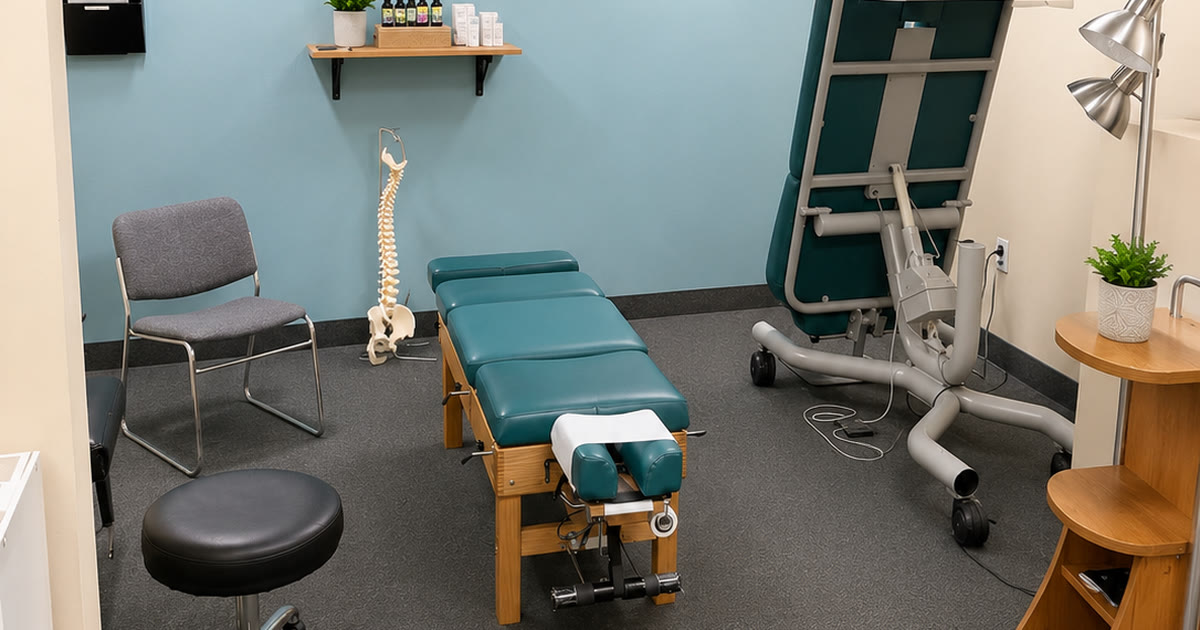
Care itself is structure-and-function focused: gentle joint mobilization and adjustment to restore normal motion, soft-tissue work for the muscles that have locked down around the injury, and progressive exercise designed to support your body's natural healing response and rebuild the endurance those deep neck muscles lost. For patients whose soft-tissue irritation is slow to settle, StemWave acoustic wave therapy is one of the options we may discuss — we've explained what StemWave therapy is and how it works in more detail. You can see the full range of what we address on our conditions page and our services page.
A Note on Documentation and Maryland PIP
We are not attorneys, and nothing here is legal advice. For anything specific to your claim, coverage, or who was at fault, talk to your insurer or a personal injury attorney.
What we can tell you from the documentation side is that delayed symptoms create a paperwork problem as well as a clinical one. A crash on the 1st with a first medical visit on the 25th leaves a three-week gap that adjusters notice and ask about, and that gap exists whether or not the injury was real. An exam performed while symptoms are emerging creates a dated record connecting what you're feeling to the event that caused it.
On the coverage side, Maryland requires a minimum Personal Injury Protection (PIP) benefit of $2,500, which reimburses reasonable and necessary medical expenses regardless of who was at fault — though drivers may waive PIP under certain conditions, so the first step is confirming your own policy actually carries it (Maryland Insurance Administration, Auto Insurance: A Consumer Guide). Whether and how that applies to your situation is a question for your insurer.
For more on the timing question specifically, see how long after a car accident you should see a chiropractor. And if your neck settled down after a previous crash only to flare up again months later, why back and neck pain keeps coming back covers the mechanics of that pattern.
Frequently Asked Questions
How long after a car accident can whiplash symptoms appear?
Most neck pain and stiffness begins within 6 to 24 hours and peaks around day 2 to 4. Headache attributed to whiplash is formally defined as developing within seven days of the injury. Symptoms like jaw pain, dizziness, and concentration problems often surface later in the first week or beyond.
Can I have whiplash if my car was barely damaged?
Yes. Research on emergency department whiplash patients found no significant correlation between estimated impact speed and neck disability at follow-up, and the vehicle was still driveable in about 62% of cases. The international diagnostic criteria explicitly note that whiplash may occur after high or low impact forces.
Is it too late to get checked if my accident was two weeks ago?
No. Earlier is better for both your recovery and your records, but a delayed evaluation is far better than none. Symptoms that are still present at two weeks are exactly the ones worth assessing, since the research shows a substantial proportion of people still have measurable disability at four to six weeks.
Do delayed whiplash symptoms mean the injury is worse?
Not necessarily. Delayed onset is normal and reflects how inflammation and protective muscle guarding develop, not how severe the underlying injury is. What does tend to predict a slower recovery is high pain intensity early on.
Should I see a chiropractor or my primary care doctor first?
Either is reasonable if you have no red-flag symptoms. If your complaints are mechanical — neck pain, stiffness, restricted motion, headache from the base of the skull — a chiropractic evaluation is well suited to assessing the joints and soft tissue involved. If anything on the red-flag list above applies, go to the emergency department first.
Car Accident Chiropractic Care in Bowie and Prince George's County
Total Wellness Chiropractic is on Laurel Bowie Road (MD-197) in Bowie, and our patients come from all over this part of Prince George's County and its neighbors — people commuting on US-50, Annapolis Road (MD-450) through Lanham, Route 214 out toward Largo, US-301 down to Upper Marlboro, and the local roads through Glenn Dale, Crofton, and Mitchellville. Stop-and-go commuter traffic is exactly the setting where rear-end collisions happen, and rear impacts are the classic whiplash mechanism: in the emergency department study cited throughout this article, 68.8% of the whiplash patients had been struck from behind.
If something started hurting a few days after your crash, get it looked at. You can book an appointment online or call the office.
Total Wellness Chiropractic 6000 Laurel Bowie Road, Suite 202 Bowie, MD 20715 (301) 352-3454 wherethehealingbegins.com
This article is for educational purposes only and is not medical or legal advice. It does not create a doctor-patient relationship and is not a substitute for an in-person evaluation by a qualified healthcare provider. If you are experiencing a medical emergency, call 911. For questions about insurance coverage or a personal injury claim, consult your insurer or a licensed Maryland attorney. Individual results may vary.