Someone stops short on Collington Road. You stop too. The car behind you doesn't.
The impact lasts about a fifth of a second. The bumpers look survivable, you exchange information, and you drive home telling yourself you got lucky. Two days later you can't back out of your own driveway without rotating your whole upper body.
Should You See a Chiropractor After a Rear-End Collision?
If you have neck pain, stiffness, headache, or restricted movement after being rear-ended, seeing a chiropractor after a rear end collision is a reasonable first step — provided you have no red-flag symptoms, which are listed below. A rear impact is the classic mechanism for the kind of joint and soft-tissue injury a chiropractic evaluation is built to assess.
But "yes, get evaluated" is not the same as "yes, sign up for three visits a week until your claim settles." The best available clinical guideline on this is specific about what helps, roughly how much of it, and which popular treatments to skip — and it is a good deal more restrained than most of what you'll read on chiropractic websites.
Why Rear Impacts Injure Necks Differently
In a rear-end collision, your seat pushes your pelvis and torso forward first. Your head, which is heavy and not attached to the seat, stays where it is for a moment. The result is a horizontal sliding of the head backward relative to the torso — biomechanists call this retraction — that compresses and shears the neck before any of it looks like the dramatic head-snap people picture.
Gunter Siegmund's review of the biomechanics of whiplash injury in the British Columbia Medical Journal describes the middle of that motion: the lower cervical vertebrae extend while the upper segments briefly flex, so the neck passes through a shape it never adopts during normal movement — all of it before your neck muscles can reflexively respond.
Rear impacts specifically are associated with both a higher risk of whiplash injury and more simultaneous symptoms than other crash directions. That's why a rear-ender that looked minor can produce more complaints than a side impact that crumpled a door.
The tissue most consistently implicated is the facet joint — the small paired joints at the back of each spinal segment — and the capsule of ligament around it. The strongest clinical evidence for that comes from Lord and colleagues, who found that numbing the small nerves supplying those joints relieved chronic post-whiplash neck pain in roughly 60% of patients studied. Those joints are precisely what a chiropractic examination assesses segment by segment.
Disclosure: Siegmund's review notes his own competing interests, including consulting for parties on both sides of legal disputes and contract research for an auto insurer. The biomechanics is well replicated.
"But the Car Was Barely Damaged"
This is the objection people arrive with, usually because someone has already said it to them.
Vehicle damage is a poor proxy for neck loading. Cadaveric testing of cervical spine segments found that, on average, strain in the facet joint capsules under whiplash-like loads was about half the strain required to cause the first detectable failure of those ligaments. That's the part the skeptics quote, and it's real.
But in 2 of the 13 specimens tested, strain under those same loads exceeded the point at which that specimen had first started to fail. The researchers' conclusion is the one worth carrying: the loads in a low-speed rear-end collision could injure the facet capsular ligaments in some individuals. Not all. Not none. Which group you're in isn't something anyone can read off the bumper.
Head restraint position matters here more than people realize. Properly positioned behind the head, it arrests the motion early; set too low or too far back, the head travels further and the neck absorbs more of the work. If you adjust nothing else after reading this, raise your headrest so the top of it is at least level with the top of your ears.
For why symptoms often don't show up at the scene, see delayed whiplash symptoms after a car accident.
First: Red Flags That Mean the Emergency Department
Chiropractic care is not a substitute for emergency evaluation. Go to an emergency department or call 911 — do not come here first — if you have any of the following after a crash:
- Loss of consciousness, even briefly, or confusion, repeated vomiting, or worsening drowsiness
- Severe or rapidly worsening headache, or a headache unlike any you've had
- Vision changes, double vision, slurred speech, or pupils of unequal size
- Weakness, numbness, or clumsiness in an arm or leg, or a change in grip strength
- Loss of bowel or bladder control, or numbness in the saddle region
- Severe midline neck pain, or any sense that your neck is unstable
- Chest pain, difficulty breathing, or abdominal pain and tenderness
- You are over 65, were in a high-speed crash, or have osteoporosis, a history of spinal surgery, or take blood thinners
Clinicians assessing a neck after trauma use a validated screening tool — the Canadian C-Spine Rule — to decide who needs imaging to rule out fracture or dislocation before anything else happens. That screen comes first in our office too, and the honest outcome of a first visit is sometimes a referral rather than treatment.
What the Evidence Actually Supports
The most rigorous guideline covering this is from the Ontario Protocol for Traffic Injury Management (OPTIMa) Collaboration, published in the European Spine Journal in 2016 — built on eight systematic reviews restricted to low-risk-of-bias studies, written by a 21-member panel spanning emergency medicine, orthopedic surgery, physical therapy, chiropractic, psychology, and health economics. You can read the full guideline recommendations yourself.
It frames the baseline this way: in Canada, 86.2% of people injured in motor vehicle collisions develop neck pain and associated disorders. It's the normal consequence of a crash, not an exotic one.
What it recommends
For recent-onset neck pain and associated disorders of the type most rear-end collisions produce — pain and stiffness, with or without reduced motion, but no neurological deficit — the guideline says clinicians may consider structured patient education combined with either range-of-motion exercise or multimodal care, meaning range-of-motion exercise together with manipulation or mobilization of the cervical and/or thoracic spine.
It gets specific about dose. For multimodal care it recommends a maximum of six sessions over eight weeks, noting that across the trials reviewed, effective multimodal care was achieved within six visits over eight weeks on average. The home exercise component is gentle: 5 to 10 repetitions with no resistance, up to six to eight times a day.
It also recommends reassessing at every visit and discharging patients as soon as they report significant recovery, using a plain question — "How well do you feel you are recovering from your injuries?" — rather than a schedule set in advance.
What it says not to do
This is the part that doesn't make it onto most chiropractic websites. For recent-onset cases, the guideline says clinicians should not offer a cervical collar, electrotherapy, clinic-based heat, relaxation massage, strain-counterstrain technique, electroacupuncture, or patient education delivered alone. Every guideline the OPTIMa team reviewed agreed collars are contraindicated for whiplash.
And one sentence that should govern how any honest office runs a personal injury case: there is no evidence that effectiveness can be increased through more frequent attendance or a prolonged course of treatment. More visits is not more care.
The guideline is equally blunt about the ceiling: all recommended interventions provide small benefits at best. Anyone promising a fix is selling something.
Disclosure, as always: the OPTIMa guideline was funded by the Ontario Ministry of Finance and the province's financial services regulator — a funder with an interest in auto injury costs. The panel states the funder did not influence the recommendations, and the methodology is among the most transparent in this literature, but you should know who paid for it.
What the First Visit Actually Looks Like

A first evaluation after a rear-end collision is mostly assessment, not treatment.
We take a detailed history of the crash — direction of impact, whether you saw it coming, head position at contact, whether the headrest was up, whether the airbag deployed. Each changes what we expect to find.
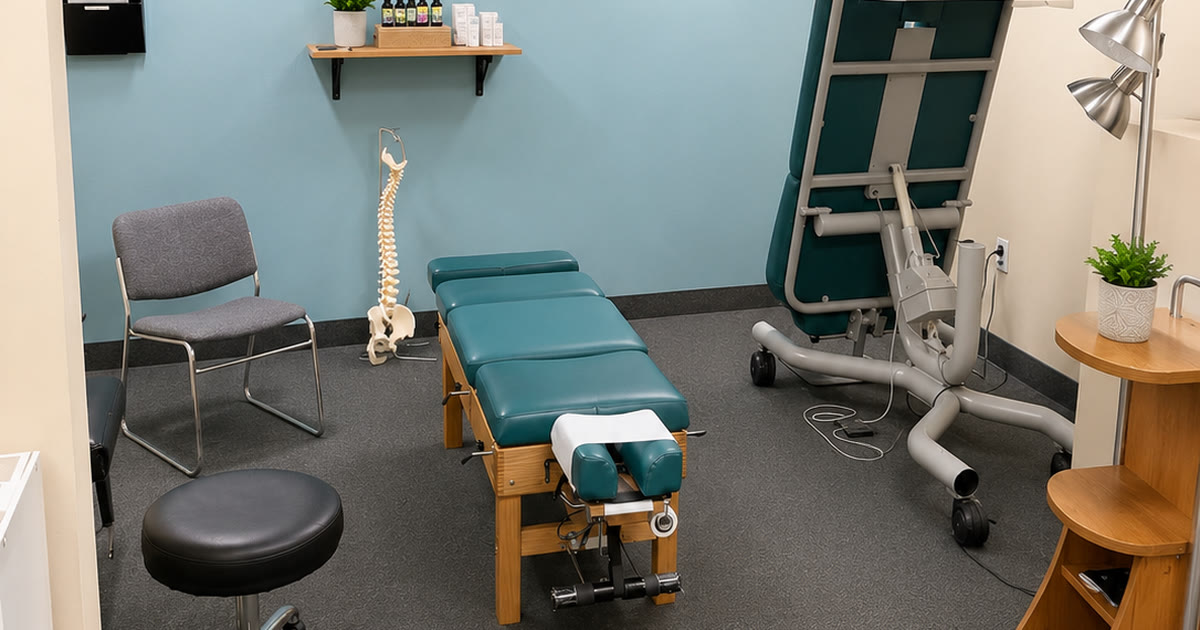
Then a physical examination: screening for the red flags above, range of motion in each direction, segment-by-segment assessment of the cervical and thoracic spine, muscle testing, reflexes, and sensation in both arms. If anything suggests a fracture, a disc injury with nerve involvement, or a concussion, you get referred out. That is a normal first-visit outcome, not a failure of one.
If the findings are mechanical, we explain them in plain language, show you the daily home movement, and lay out a short, defined plan with a re-evaluation point — because expectation of recovery is itself one of the strongest predictors of how recovery goes.
See the conditions we see and services offered at our Bowie office, or book an appointment.
Who Tends to Recover More Slowly
OPTIMa asks clinicians to assess prognostic factors for delayed recovery at the outset, because the people who need closer follow-up are identifiable early. Its list:
- Older age
- A history of neck pain before the crash
- High pain intensity in the first days
- High initial disability — a big gap between what you could do before and what you can do now
- A poor personal expectation of recovery
- Symptoms of acute stress in the first four weeks, or post-traumatic stress symptoms lasting beyond that
- Low mood, anxiety or fear about the pain, or high frustration and anger about it
- Passive coping, and avoiding activity out of fear that movement will cause harm
Several of those are psychological, and that isn't a euphemism for "imaginary." Fear of movement measurably slows recovery from a mechanical injury, which is exactly why the guideline puts reassurance and staying active at the center of care instead of rest and a collar.
If neck or back pain kept returning even before this crash, why back pain keeps coming back covers the same pattern in the lower back. For persistent tendon and soft-tissue pain that hasn't responded to a standard course of care, StemWave acoustic wave therapy is another option we can discuss — $50 first session.
How This Gets Paid For in Maryland
General information, not legal advice. The specifics of your policy and your claim belong with your insurer or a licensed Maryland attorney.
Personal Injury Protection. Maryland law requires insurers to offer policyholders at least $2,500 in Personal Injury Protection (PIP) coverage. Per the Maryland Insurance Administration's consumer auto insurance guide, PIP reimburses reasonable and necessary medical expenses and lost wages, and that reimbursement "will be made regardless of who caused the accident." You may have waived PIP or bought limited PIP to lower your premium — check your declarations page rather than assuming.
Does using PIP raise your rates? The MIA guide answers directly: "Maryland law prohibits an insurer from increasing your premium (including surcharging, reclassifying, or removing a discount) as a result of a claim or payment made under PIP coverage." One nuance from the same guide, which we'd rather you hear from us: an insurer may cancel or non-renew a policy if you file three or more not-at-fault claims within three years, and it lists a PIP claim as an example. A premium increase and a non-renewal are different things, and only the first is prohibited.
Filing deadline. There isn't a number in the MIA guide — only that "PIP coverage can be denied if claims are not properly and timely filed with your insurer," and to contact your insurer immediately and request PIP forms. Treat that as: request the forms this week.
Medical Payments. MedPay is optional, and the MIA guide specifically names chiropractic among the expenses it may cover. Most policies require PIP to be exhausted first.
The three-year deadline. Under Maryland Courts and Judicial Proceedings § 5-101, "a civil action at law shall be filed within three years from the date it accrues unless another provision of the Code provides a different period of time." Three years is a long time to file a lawsuit and a terrible amount of time to wait before getting your neck looked at. Separate clocks.
We document what we find and what we do. We do not value claims, predict settlements, or advise on legal strategy.
Why the Date of the First Visit Matters
Beyond recovery, the first visit sets a baseline: range of motion, what hurt, what you couldn't do. Everything after is measured against it. A file that starts six weeks out has no baseline, and that gap becomes a question someone will ask. Same for gaps in the middle — if your schedule falls apart, tell us and we'll note it rather than leave an unexplained hole in the record.
How long after a car accident you should see a chiropractor covers timing, and what to do after a car accident in Bowie, MD covers the first 48 hours.
Frequently Asked Questions
Should I see a chiropractor after a rear end collision if nothing hurts yet?
A same-week evaluation is reasonable even if you feel fine, because symptoms after a rear impact commonly appear hours to days later. With no symptoms and no red flags there's no urgency to treatment — but there is value in a baseline exam while the crash details are fresh.
How many chiropractic visits should I expect after being rear-ended?
The OPTIMa guideline recommends a maximum of six sessions over eight weeks of multimodal care for recent-onset cases, and notes no evidence that more frequent or longer courses work better. Some people need fewer. A longer plan should be justified at a re-evaluation, not set in advance.
Can I have a real injury if my car barely had a scratch?
Sometimes, yes. In cadaveric testing, facet capsular ligament strain under low-speed whiplash loads exceeded that specimen's own first failure threshold in 2 of 13 specimens — so those loads can injure some individuals even when vehicle damage is minor.
Should I wear a neck collar after a rear-end collision?
Every guideline reviewed by the OPTIMa team advises against cervical collars for whiplash — immobilization produces deconditioning and reinforces fear of movement. Staying gently active is what the evidence supports.
Do I need a lawyer before I get treated?
No — getting evaluated and getting legal advice are independent decisions. We provide records to whomever you direct us to.
What if the crash was months ago?
Get evaluated anyway. Earlier is better, but persistent symptoms months out are exactly the ones worth assessing, and the guideline has a separate pathway past the three-month mark.
Is chiropractic care safe for whiplash?
Manipulation and mobilization are among the interventions OPTIMa includes in its recommended multimodal care for recent-onset cases, alongside exercise and education — assuming major pathology has been ruled out first, which is why the examination comes before anything else.
Chiropractic Care After a Rear-End Collision in Bowie and Prince George's County
Total Wellness Chiropractic is on Laurel Bowie Road (MD-197) in Bowie, and our patients commute across this whole part of Prince George's County — US-50 east and west, Annapolis Road (MD-450) through Lanham, Route 214 toward Largo, US-301 down to Upper Marlboro, MD-3 north, and the local roads through Glenn Dale, Crofton, and Mitchellville. Stop-and-go corridors are where rear-end collisions live. In one emergency department series of whiplash patients, 68.8% had been struck from behind.
If you were rear-ended anywhere in Prince George's County and something in your neck, upper back, or head isn't right, get it assessed. Book an appointment online or call the office.
Total Wellness Chiropractic 6000 Laurel Bowie Road, Suite 202 Bowie, MD 20715 (301) 352-3454 wherethehealingbegins.com
This article is for educational purposes only and is not medical or legal advice. It does not create a doctor-patient relationship and is not a substitute for an in-person evaluation by a qualified healthcare provider. If you are experiencing a medical emergency, call 911. For questions about insurance coverage or a personal injury claim, consult your insurer or a licensed Maryland attorney. Individual results may vary.